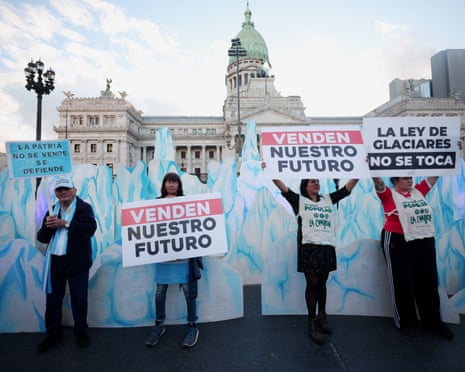
Argentina's lower house has passed a legislative amendment that makes it easier to conduct mining operations in glacier-adjacent regions, according to congressional records.
The new law modifies the 2010 Glacier Law, which previously prohibited all mining and exploration activities within glacier zones to protect vital water reserves.
Under the reform, the responsibility for defining protected glacier areas moves from the Argentine Institute for Snow, Ice and Environmental Sciences (Ianigla) to provincial authorities.
President Javier Milei backed the reform, stating the change "empowers the provinces to utilise their resources" and permits mining "where there was nothing to protect."
Provincial control over water reserves
Proponents of the bill, including governors from the mineral-rich provinces of Catamarca, Jujuy, Salta, Mendoza, and San Juan, argue the previous law hindered economic development.
Congresswoman Nancy Picón Martínez defended the measure, arguing that the mining industry is being portrayed "as if it were a monster."
"This law protects glaciers, no matter how much some people want us to believe otherwise," Martínez said.
Opponents argue the shift threatens the nation's primary freshwater sources. Congresswoman Natalia de la Sota noted that without water, large-scale development projects cannot exist.
Following the reform, glaciers and periglacial environments will remain under the national Ianigla inventory only until provincial leaders prove they do not serve as "strategic" water reserves.
Argentina contains 16,968 glaciers that supply water to 36 river basins across 12 provinces, supporting approximately seven million people.
Environmental groups, including Greenpeace, warn that the amendment ignores the role of periglacial environments in feeding rivers.
"The primary function of all glaciers and the entire periglacial environment is to act as a freshwater reservoir," said Agostina Rossi Serra, a biologist with Greenpeace.
Rossi Serra noted that many of the provinces seeking the amendment reside in arid or semi-arid regions where water scarcity is a growing issue due to climate change.