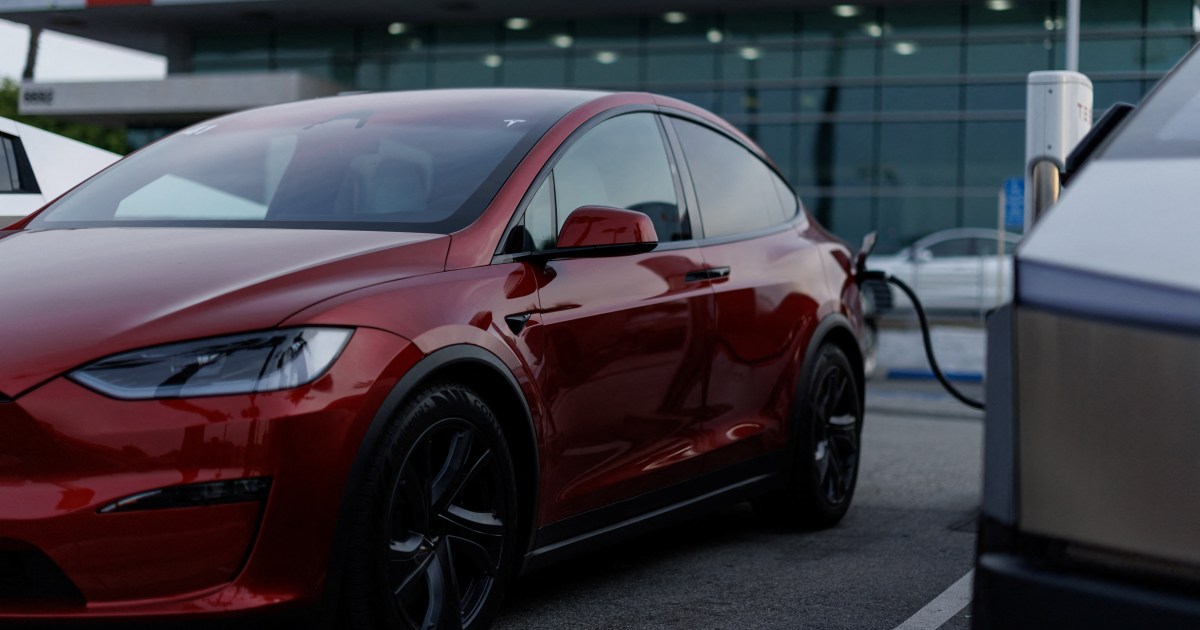
Tesla, Inc., the electric vehicle titan steered by Elon Musk, has registered its inaugural annual revenue decline, a significant marker suggesting maturation and potential saturation in the global EV market. For the full year 2025, the Austin-based firm reported revenue of $94.8 billion, a contraction from the $97.7 billion achieved in 2024. Quarterly figures were equally telling, with Q4 2025 revenue slipping 3% year-on-year to $24.9 billion, accompanied by a sharp 61% drop in net profit to $840 million.
This downturn in the automotive core was contextualized by a major strategic reallocation of capital. Tesla disclosed an agreement to channel $2 billion into xAI, Musk’s artificial intelligence startup responsible for the Grok chatbot. The company explicitly framed this investment as a critical step toward mitigating its dependence on the cyclical auto industry, underscoring a deepening commitment to AI deployment in physical applications.
The market reaction was muted but positive in extended trading, with Tesla shares climbing approximately 2.2%, perhaps reflecting investor confidence in the long-term AI thesis over near-term automotive performance. This financial disclosure occurred on a day dominated by generally strong earnings reports from major technology conglomerates.
In stark contrast to Tesla’s contraction, industry peers demonstrated robust expansion fueled by the artificial intelligence boom. Meta Platforms reported Q4 profit soaring to $22.8 billion on revenues of $59.9 billion, driving its shares up nearly 7%. Similarly, Microsoft posted a 60% profit surge to $38.5 billion for the quarter, cementing its leadership in enterprise AI infrastructure.
Microsoft CEO Satya Nadella emphasized the nascent stage of AI diffusion, noting that the company’s AI business already rivals its largest franchises. However, even Microsoft faced investor scrutiny regarding the sustainability of its infrastructure build-out, as record capital spending of $37.5 billion stoked broader concerns about an escalating AI investment bubble, leading to a stock price decline.
Further evidence of semiconductor strength, crucial for AI advancement, came from Samsung Electronics. The world’s leading memory chip producer announced first-time quarterly profits exceeding $13.9 billion on revenues of $65.6 billion, reflecting a massive three-fold increase year-on-year.
Tesla’s shift toward AI integration, financed partly by internal capital and strategic necessity following slowing auto demand, places it in direct competition for talent and resources with established giants like Microsoft and specialized AI labs. The coming fiscal cycles will test whether this vertical integration strategy can re-accelerate growth and justify the diversion of capital from its established manufacturing base.
This data, sourced from Tesla’s earnings report released Wednesday, underscores a pivotal moment where the future valuation of automotive manufacturers increasingly hinges on their demonstrated capacity to translate industrial scale into cutting-edge artificial intelligence deployment. (Source: Al Jazeera reporting on corporate earnings data.)