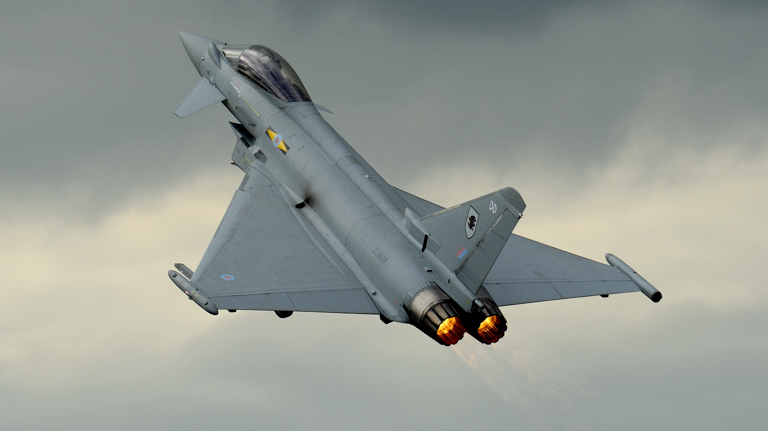
The Royal Air Force (RAF) recently completed a key trial at a test center in Lancashire, England, successfully validating the integration and deployment of a laser-guided rocket system on its Typhoon fighter jets. Led by defense contractor BAE Systems, the test aimed to enhance the aircraft's ability to intercept unmanned aerial vehicles (UAVs) in complex combat environments.
The system, known as the Advanced Precision Kill Weapon System (APKWS), is not a new weapon in itself. Instead, it utilizes a conversion kit fitted to standard Hydra 70 unguided rockets, transforming them into precision-guided munitions. The kit adds a mid-body guidance section—complete with control fins and a laser seeker—between the rocket motor and the warhead, allowing the projectile to lock onto and track laser-designated targets.
A Low-Cost Anti-Drone Solution
BAE Systems highlights that the primary advantage of the APKWS is its price point. Industry estimates place the cost per unit at under $40,000, significantly cheaper than typical air-to-air missiles. This cost structure offers a distinct economic advantage when engaging low-cost drones, such as the Iranian-made Shahed.
Although the APKWS achieved initial operational capability as early as 2012, global military interest has surged alongside the rapid proliferation of drone threats. Late last year, the Pentagon awarded a $322 million contract for thousands of these laser-guided rockets. Furthermore, the system has already been tested on U.S. F-15E fighters and has reportedly been deployed by F-16s in the Red Sea to counter Houthi drone attacks.
BAE Systems stated that the collaborative test with the RAF was designed to provide critical data for integrating low-cost precision weapons onto combat aircraft. In a statement, the company noted that this is part of a broader series of capability enhancements for the Typhoon, aimed at ensuring the platform remains effective in future operational theaters.
Previously, the Royal Navy’s Wildcat helicopters were cleared to carry the Martlet lightweight multi-role missile, which also features laser-guidance capabilities. Some Martlet missiles have already been deployed to RAF Akrotiri in Cyprus to bolster defenses against drone incursions. The UK Ministry of Defence has yet to confirm whether the APKWS will be formally adopted for frontline service on the Typhoon fleet.