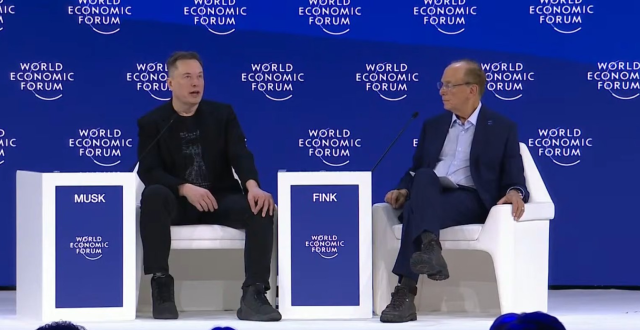
Elon Musk appeared at the World Economic Forum in Davos on Thursday to discuss the future of technology with BlackRock CEO Larry Fink. The billionaire entrepreneur identified electricity supply as the primary constraint hindering widespread artificial intelligence adoption globally. He stated that chip production capabilities are currently outpacing the growth rate of global power infrastructure significantly. Musk emphasized that energy availability dictates the speed of AI integration across virtually every industry sector today.
During the conversation, Musk highlighted China as a leader in renewable energy capacity compared to the United States. He noted that China has installed solar capacity exceeding 1000 gigawatts annually, which supports significant industrial output. In contrast, the US power grid grows at a rate of approximately 3% to 4% per year. This disparity creates a bottleneck for American semiconductor manufacturing and data center expansion.
The tech mogul proposed that deploying AI infrastructure in space offers the lowest cost solution for the near future. Musk predicted that space-based AI data centers could become economically viable within two to three years. This approach leverages the constant sunlight available in orbit without atmospheric interference. He argued that the temperature in space also provides natural cooling for high-performance computing hardware. Solar panels in orbit generate five times more electricity than those on the ground due to constant exposure.
Regarding robotics, Musk outlined a timeline for the deployment of humanoid robots to address labor shortages. He stated that Tesla plans to sell Optimus robots to the general public by the end of next year. These machines aim to assist with caregiving tasks and household management as populations age. The company expects these units to achieve high reliability before entering the consumer market.
Musk also addressed the biological limits of humanity during the interview segment on longevity. He acknowledged that reversing aging is scientifically possible but warned against the societal stagnation of immortality. He described a biological clock that regulates the aging process across 35 trillion cells in the human body. According to Musk, death serves an evolutionary purpose that maintains social dynamism. He noted that no single arm ages differently than the other within a human subject.
On the topic of autonomous driving, the Tesla leader confirmed that full self-driving approval is imminent in European markets. He indicated that regulatory progress in China is moving at a similar pace to European standards. Musk claimed that the technology to solve autonomous navigation is fundamentally solved at this stage. Insurance companies are already offering premium discounts based on safety monitoring data. He expects Robotaxi services to become widespread in the United States by the end of this year.
SpaceX is simultaneously working on achieving full reusability for its Starship rocket system this year. Musk explained that discarding upper stages currently costs as much as a small jet aircraft per flight. Proving full reusability could reduce launch costs by a factor of 100 compared to current methods. This reduction is critical for making interplanetary travel and large satellite deployments economically feasible. He stated that the goal is to lower the cost per pound below that of air freight.
Looking ahead, Musk forecasted that global artificial intelligence would surpass the combined intelligence of all humans by 2030 or 2031. He attributed this rapid growth to the exponential decrease in AI model costs and the expansion of open-source models. The technology firm believes that widespread access to AI will drive unprecedented economic growth. Fink noted that Tesla has delivered a 43% compound annual return since its public listing. He contrasted this with the 21% return rate of BlackRock over a similar period.
The interview concluded with a message of optimism regarding human progress and technological advancement. Musk advised the audience to remain optimistic about the future even if occasional errors occur. He contrasted this mindset with a pessimistic outlook that he views as less productive for society. The discussion underscored the importance of balancing innovation with societal well-being.