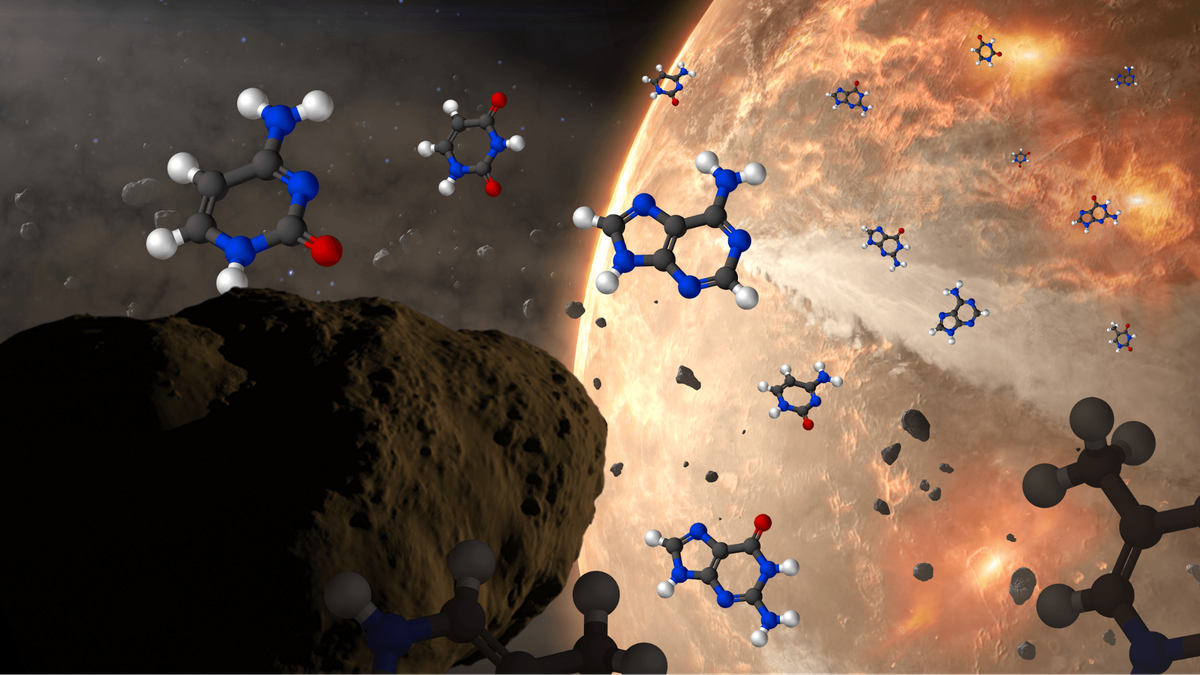
Researchers have identified all five nucleobases necessary for DNA and RNA within pristine samples from the asteroid Ryugu. This finding appears in a study published Monday in Nature Astronomy and strengthens the hypothesis that life's building blocks originate in space. The discovery confirms that the chemical starting materials for life exist abundantly within the solar system, suggesting a cosmic distribution of prebiotic matter.
A team analyzed rocks collected from the surface of Ryugu in 2019 by the Japanese spacecraft Hayabusa-2. The mission successfully returned these samples to Earth the following year for detailed laboratory examination by international scientists. Researchers identified adenine, guanine, cytosine, thymine, and uracil within the carbon-rich material retrieved from the near-Earth object.
This discovery corroborates results from NASA’s OSIRIS-REx mission, which found the same five bases in samples from asteroid Bennu. Both asteroids belong to the carbonaceous family of primitive rocks, yet they contain different ratios of the identified nucleobases. Together, these findings provide a broader picture of chemical distribution across the early solar system and the conditions present during planetary formation.
Toshiki Koga, a postdoctoral researcher at the Japan Agency for Marine-Earth Science and Technology, commented on the significance of the data. He stated that nucleobases may be widespread in carbonaceous asteroids and potentially in planetary systems beyond our own. Koga noted that while life itself is not necessarily common, the molecular ingredients appear more accessible than previously thought for biological processes.
Understanding the emergence of life on Earth remains one of the most significant mysteries in modern science and requires extensive investigation. Researchers must determine how our planet became enriched with water, amino acids, and genetic material during its formation over four billion years ago. One leading hypothesis suggests that asteroids pelted Earth frequently, delivering these essential components to the developing surface.
Previous studies relied on meteorites like Murchison or Orgueil, which risk contamination after landing on Earth and exposure to the atmosphere. Spacecraft missions now allow scientists to access cleaner samples directly from the source without terrestrial interference or degradation. Hayabusa-2 and OSIRIS-REx brought back 5.4 grams and 121.6 grams of material respectively for analysis in controlled environments.
The results lend weight to the RNA world model of abiogenesis, where early life depended on RNA as a self-replicating molecule. Evidence suggests that at least some nucleobases forming these early lifeforms originated from outer space rather than Earth alone. Koga described the confirmation as broadly in line with expectations but satisfying to verify given the precision of the instruments used.
Despite containing the full set of bases, the samples from Ryugu and Bennu differ in their relative abundances of specific chemical compounds. Bennu is much richer in pyrimidine nucleobases compared to Ryugu, though both show similar levels of purine nucleobases. These variations indicate different formation processes within the parent bodies of these celestial relics and the environments they inhabited.
Local chemical environments, such as the availability of ammonia, may play an important role in nucleobase formation within the asteroid interiors. Some precursor molecules might have formed earlier in interstellar environments before reaching the asteroid parent bodies during the solar system's infancy. Future studies will analyze different meteorites and simulate these conditions in laboratory settings to trace the exact pathways.
Understanding how these molecules form in space helps answer whether life is a rare cosmic fluke or a common process throughout the universe. The research highlights the ingenuity behind sample-return missions delivering time capsules from the birth of our solar system directly to researchers. Scientists feel a strong responsibility to analyze each grain for information on organic evolution before the origin of life occurred.