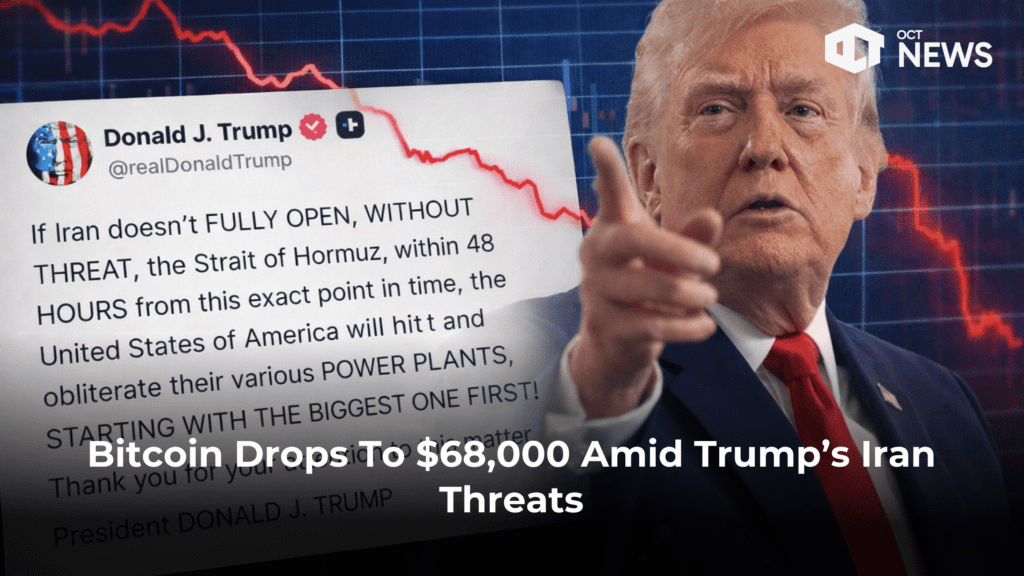
Bitcoin traded below $68,000 on Sunday following a sharp escalation in Middle East tensions involving the United States and Iran. President Donald Trump issued a 48-hour ultimatum to Tehran regarding the Strait of Hormuz. The threat involves potential strikes on Iranian power infrastructure if shipping lanes remain blocked. This geopolitical shock reverberated through global financial markets within minutes of the announcement. The move marks a significant pivot from recent diplomatic signals regarding the ongoing conflict.
Market data indicates over $1 billion in crypto liquidations occurred within hours of the announcement. Roughly $980 million in long positions were cleared out during the volatility spike. Bitcoin had been consolidating between $69,000 and $71,000 prior to the geopolitical shock. The drop extended a week-long selloff tied to renewed uncertainty. Analysts warn that thin liquidity below $70,000 accelerated the move significantly.
This development reverses a narrative that emerged just 24 hours earlier. Trump previously suggested the conflict was winding down, which had stabilized sentiment. The sudden policy shift triggered immediate risk-off behavior across digital asset markets. Investors reacted swiftly to the change in administration rhetoric regarding the region. Such volatility highlights the sensitivity of risk assets to geopolitical headlines.
The 2026 Iran conflict began with Operation Epic Fury airstrikes on February 28. Targets included missile sites and nuclear facilities, resulting in the death of Supreme Leader Ali Khamenei. Iran retaliated with missiles aimed at Gulf bases and commercial shipping. The Strait of Hormuz handles roughly 20% of global oil supply. Disruption to this chokepoint rattled energy and financial markets simultaneously.
Energy markets reacted aggressively to the threat of supply disruption. Brent and WTI crude prices surged over 40% from pre-war levels according to Business Insider. Oil prices spiked to $100 per barrel or higher during previous Hormuz disruptions. This volatility rattled energy and financial markets at the same time. The correlation between oil and crypto remains strong during crises. Traders watched tanker movements closely for signs of blockage.
Traditional equities also suffered during the escalation period. The S&P 500 dropped over 2% since the conflict started, per Reuters reports. Energy and defense stocks outperformed while broader indices experienced drawdowns. Gold initially rallied toward $5,000 per ounce at peaks during the crisis. Dollar strength and rising rate concerns weighed on precious metals. Investors sought safety in the US dollar and treasury bonds.
Bitcoin demonstrated resilience compared to equities during the initial shock. The asset reclaimed $68,000 within hours of the opening weekend sell-off. Higher lows formed at $66,000, then $68,000, and finally $69,400 by mid-March. BTC outperformed gold over the same period, according to Yahoo Finance. Short squeezes and ETF inflows fueled the climb before the drop.
Technical analysts identify $68,000 as a critical support level for the current cycle. A decisive break below could trigger approximately $608 million in further liquidations. Thin liquidity below this threshold accelerated the downward move once sellers took control. If the level fails decisively, cascading effects could follow. Market structure suggests a vulnerable zone for leveraged positions.
Geopolitical stability also impacts Bitcoin mining operations in the region. Iran contributes a notable share of global hashrate to the network. Disruption to power plants could reduce mining capacity and affect network security. This factor remains overlooked by many market participants during price analysis. The potential impact on mining adds another layer of complexity to the situation.
The 48-hour window from the ultimatum expires around March 23. Markets remain highly sensitive to headlines regarding the strait and oil flows. De-escalation signals could allow BTC to recover quickly based on mid-March patterns. Trump’s stated objectives have shifted to securing the Strait of Hormuz. This is not financial advice as geopolitical events can move prices in either direction.