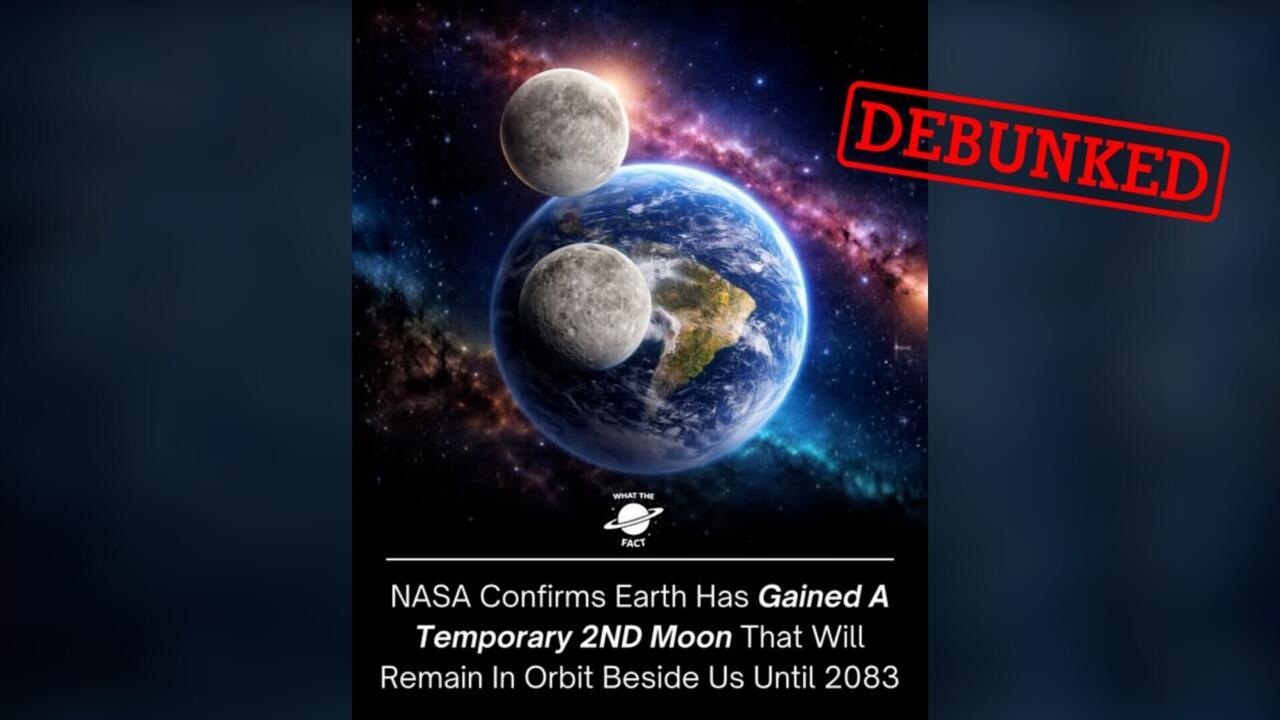
A significant wave of misinformation has swept across digital platforms, asserting that NASA has confirmed the discovery of a temporary second natural satellite orbiting Earth. These claims, amplified by social media accounts and accompanied by visually compelling, yet wholly fabricated, Artificial Intelligence-generated imagery depicting a twin Moon, have garnered millions of views globally.
The sensational reports, exemplified by posts reaching over three million views on platforms like X, leverage public fascination with celestial events. However, factual analysis reveals the genesis of this confusion lies in the legitimate, though often misunderstood, identification of a small Near-Earth Object (NEO).
Scientists, including researchers from the Complutense University in Madrid, identified the object designated '2025 PN7' last July. While its orbital path shares similarities with Earth's, this proximity does not classify it as a true moon. According to astrophysicists, a true moon maintains a stable gravitational link, orbiting the planet itself.
Éric Lagadec, an astrophysicist at the Côte d’Azur Observatory, clarified the distinction: "'2025 PN7' isn’t a new moon. A moon orbits around a planet that it is linked to by gravity... This asteroid, however, is not orbiting our planet. It is what is called a 'quasi-moon' or a 'quasi-satellite': it orbits the sun, but its trajectory follows Earth’s trajectory."
NASA data confirms that 2025 PN7 orbits the Sun, contrasting sharply with the Moon's Earth-centric orbit. The object, estimated to be only 19 meters in diameter, lacks the gravitational influence to affect terrestrial phenomena such as tides, unlike our established satellite.
The primary driver of the public confusion appears to be the deliberate conflation of scale. The viral AI images depict the NEO as comparable in size to the Moon (approximately 3,400 km in diameter), whereas the asteroid is diminutive. Such visual distortion, experts suggest, risks feeding broader conspiracy narratives regarding astronomical observations.
This episode underscores the increasing challenge for established scientific institutions to manage the rapid dissemination of visually persuasive, yet factually baseless, content in the digital information ecosystem. The object remains a point of scientific interest for trajectory modeling but poses no threat and holds no status as a 'second moon.'
*This report is adapted and synthesized from original coverage regarding the scientific identification of asteroid 2025 PN7 and the subsequent social media dissemination.*