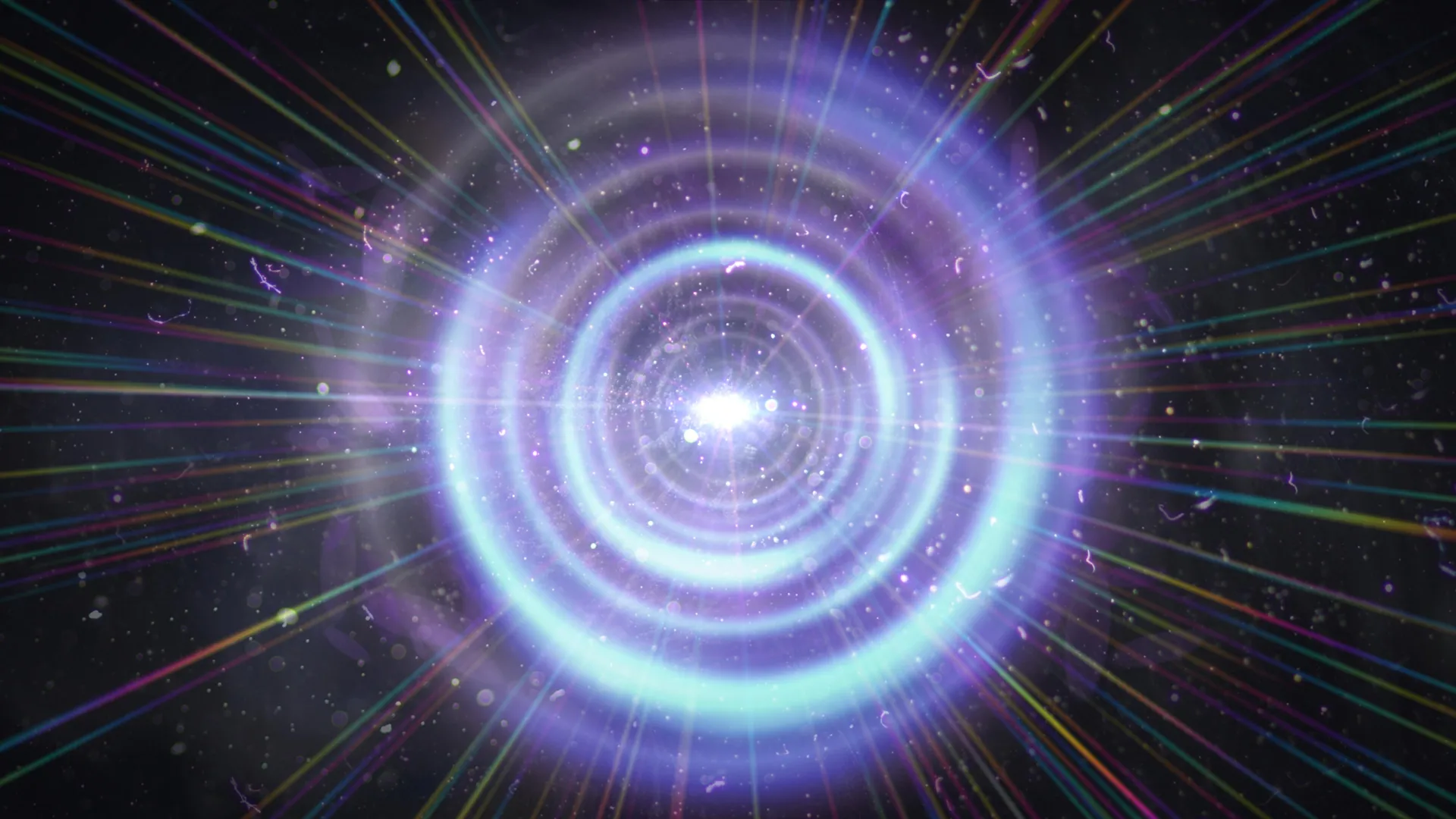
Scientists at the University of Waterloo have proposed a new framework to explain the origin of the universe. Their findings suggest the Big Bang emerged naturally from a theory known as quantum gravity. The research appeared in Physical Review Letters on March 30, 2026.
Key Findings
Dr. Niayesh Afshordi led the team exploring how to combine gravity with quantum physics. Einstein's general relativity works well but fails under extreme conditions present at the universe's birth. The researchers utilized Quadratic Quantum Gravity to remain mathematically stable at high energies.
Most current explanations rely on general relativity along with additional elements to make models work. In contrast, this new approach provides a more unified picture linking earliest moments to today's models. The team discovered the universe's rapid early expansion arises naturally from this consistent theory.
Future Implications
The model predicts a minimum level of primordial gravitational waves created shortly after the Big Bang. Future experiments may detect these signals, giving scientists a rare opportunity to test ideas about quantum beginnings. Afshordi stated that explosive early growth can come directly from a deeper theory of gravity itself.
"Instead of adding new pieces to Einstein's theory, we found that the rapid expansion emerges naturally once gravity is treated in a way that remains consistent at extremely high energies," Afshordi said.
The researchers were surprised by how testable their ideas turned out to be. Even though this model deals with incredibly high energies, it leads to clear predictions. This work arrives at a time when cosmology is becoming increasingly precise.
New instruments are now capable of measuring the universe with unprecedented accuracy. Upcoming galaxy surveys and gravitational wave detectors are reaching the sensitivity needed to examine theoretical ideas. Scientists are recognizing the limits of current early universe expansion models.
The study also involved Ruolin Liu, a PhD student at Waterloo, and Dr. Jerome Quintin, a lecturer at l'École de technologie supérieure. The team plans to refine its predictions for future experiments and investigate connections to particle physics. Their long-term goal is to build a stronger link between quantum gravity and observable cosmology.
Materials provided by University of Waterloo indicate the team has published the paper titled "Ultraviolet completion of the Big Bang in quadratic gravity." This research highlights the need for approaches grounded in fundamental physics over simpler models. The findings mark a significant step toward understanding the universe's earliest moments.