Researchers at the University of Konstanz have identified a novel form of sliding friction that operates without physical contact. Their findings challenge Amontons' law, a fundamental principle of physics established over 300 years ago regarding surface resistance. This discovery suggests that energy dissipation can occur through magnetic interactions rather than mechanical wear, according to materials released by the university.
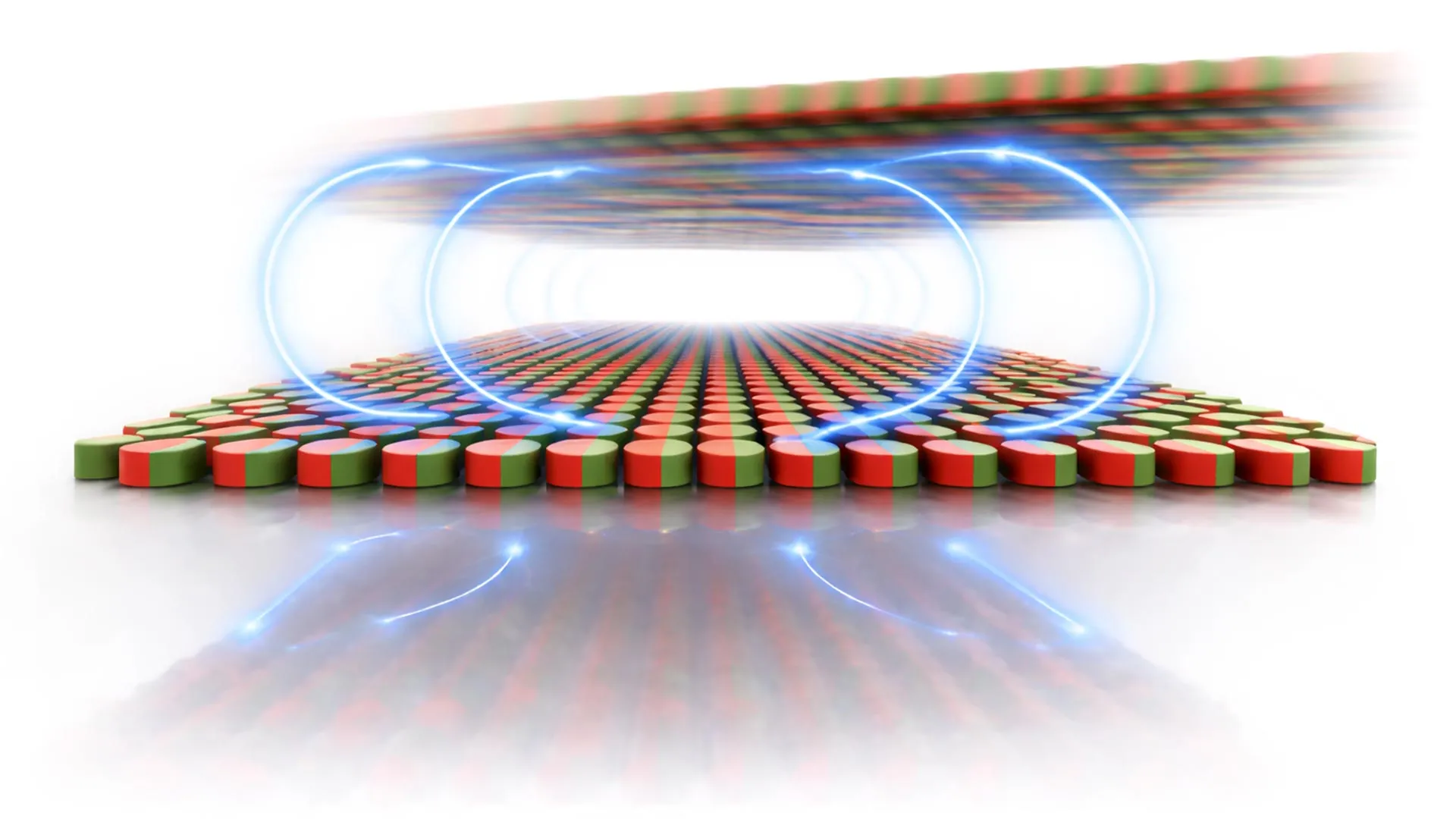
The team conducted a tabletop experiment utilizing a two-dimensional array of rotating magnetic elements positioned above a second magnetic layer. Although the two layers never physically touched, their magnetic interaction produced a measurable friction force. By adjusting the distance between the layers, the researchers controlled the effective load while observing structural changes in real time.
For centuries, Amontons' law linked friction directly to the force pressing two surfaces together, assuming heavier objects create more microscopic contact points. Traditional materials deform slightly under pressure, increasing resistance during motion without altering internal structures significantly. Magnetic materials differ because movement can rearrange their internal magnetic order, potentially breaking this linear relationship permanently.
Results revealed an unexpected pattern where friction peaked at intermediate distances rather than increasing steadily with load. This effect arises from competing magnetic preferences between the upper and lower layers of the experimental setup. The upper layer aligns antiparallel while the lower layer prefers parallel arrangements, forcing the system into an unstable state constantly.
"By changing the distance between the magnetic layers, we could drive the system into a regime of competing interactions where the rotors constantly reorganize as they slide," said Hongri Gu, who carried out the experiments. As the layers move, magnets switch between incompatible configurations in a hysteretic manner. This constant switching increases energy loss and produces a pronounced peak in friction.
Anton Lüders explained that friction here originates from the collective dynamics of magnetic moments rather than physical surface contact. The competing magnetic interactions naturally drive repeated reorientations during motion, leading to a friction force that does not change linearly with load. According to Lüders, the breakdown follows directly from the behavior of magnetic ordering during sliding.
Clemens Bechinger, who supervised the project, noted that dissipation is generated solely by collective magnetic rearrangements without wear or surface roughness. From a theoretical perspective, the system demonstrates that friction does not always require physical touch to exist. This challenges the conventional understanding of tribology and material science significantly.
Because the underlying physics does not depend on scale, these findings could apply far beyond the current experimental setup. Similar effects may occur in atomically thin magnetic materials where even small movements alter magnetic order. This opens new ways to study and control magnetism using friction measurements in advanced materials globally and in high-tech manufacturing sectors.
Looking ahead, the research suggests the possibility of friction that can be tuned without physical wear through magnetic hysteresis. By using remote adjustment, it may become possible to create adaptive damping systems and frictional metamaterials. Potential uses include micro and nanoelectromechanical systems where wear limits device lifespan significantly affecting industrial output and maintenance costs.
More broadly, magnetic friction provides a new way to study collective spin behavior through mechanical measurements. This links the fields of tribology and magnetism in a new way with potential industrial applications worldwide. Researchers will likely focus on integrating these principles into next-generation hardware and bearings soon.