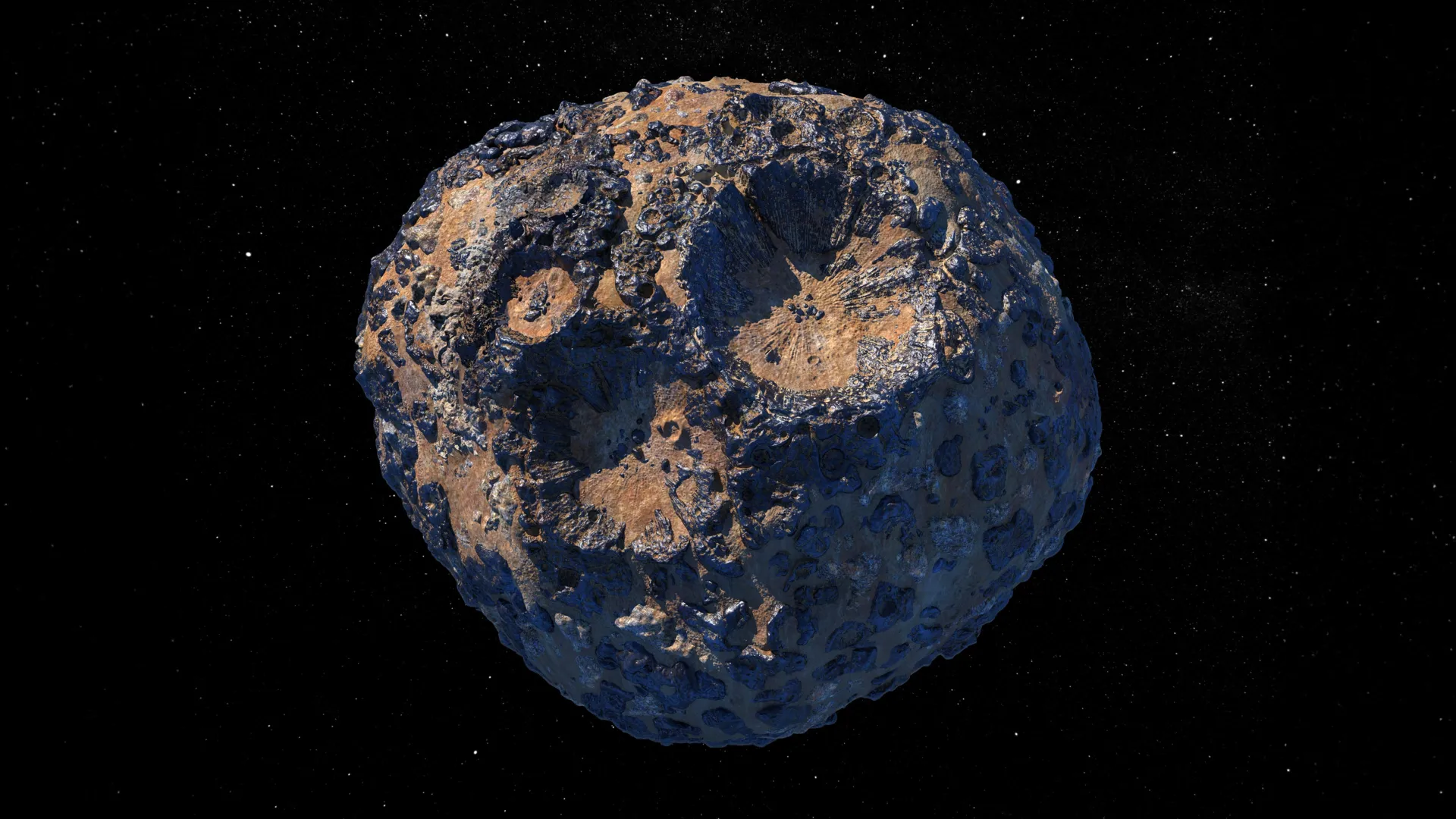
Researchers at the University of Arizona have published new simulations regarding the mysterious asteroid 16 Psyche. Their findings suggest that internal porosity plays a critical role in how massive craters form on the metallic object. This research aims to clarify whether the asteroid represents the exposed core of a failed planet. The study was released on March 17, 2026, by the university.
Scientists created detailed models to understand how a large crater near the asteroid's north pole developed. They estimated the impactor was roughly three miles across and struck at speeds of three miles per second. The resulting excavation would create a depression approximately 30 miles wide and three miles deep. These dimensions match current observations of the surface features.
One of the primary discoveries involves the amount of empty space contained within the asteroid's interior. Researchers found that higher porosity allows the material to absorb impact energy more effectively. This process leads to deeper and steeper craters with less debris scattered across the surface. Previous models often ignored this factor due to modeling difficulties.
Namya Baijal, a doctoral candidate at the Lunar and Planetary Laboratory, stated that large impact basins excavate deep into the asteroid. She explained that these excavations provide clues about what the interior is made of. By simulating the formation of one of the largest craters, the team made testable predictions for the upcoming mission. The findings were published in the Journal of Geophysical Research: Planets.
Asteroid 16 Psyche ranks as the 10th-most massive object in the main asteroid belt between Mars and Jupiter. It measures about 140 miles across and remains the largest known object made primarily of metal. Although metal-rich asteroids make up less than 10% of the belt, Psyche is the most significant among them. Scientists suspect it could be a remnant of an early planet torn apart by collisions.
Erik Asphaug, a professor in the Laboratory, compared the research approach to examining the remains of an abandoned pizza shop. He noted that while the cooks have left, the ovens and scraps allow researchers to infer how the pizzas were made. This analogy highlights how studying asteroids provides insight into planetary formation processes. Direct access to planetary cores on Earth or Mars remains impossible.
The team tested two main interior structures to see which scenario best matched the observed crater data. One model suggests a layered structure with a metallic core and a thin, rocky mantle. The other proposes a uniform mixture of metal and silicate created by catastrophic impacts. Both scenarios remain consistent with the current crater formation data.
NASA's Psyche spacecraft is scheduled to arrive at the asteroid in 2029 to conduct direct measurements. The mission will measure the surface, gravity, magnetic field, and composition of the object. In addition to crater shapes, the simulations predict density variations caused by past impacts. These predictions will guide the interpretation of data collected by the probe.
The mission is led by Arizona State University with Lindy Elkins-Tanton serving as principal investigator. NASA's Jet Propulsion Laboratory manages mission operations and system engineering. The spacecraft platform was built by Maxar Technologies in Palo Alto, California. This collaboration represents the 14th mission selected under NASA's Discovery Program.
When the spacecraft arrives, geochemists and geologists will interpret what they see alongside the modelers. This work gives the scientific community a head start in understanding the object's history. If Psyche is indeed an exposed core, it provides rare insight into a violent phase of planetary evolution. Future observations will determine the true nature of this lost world.