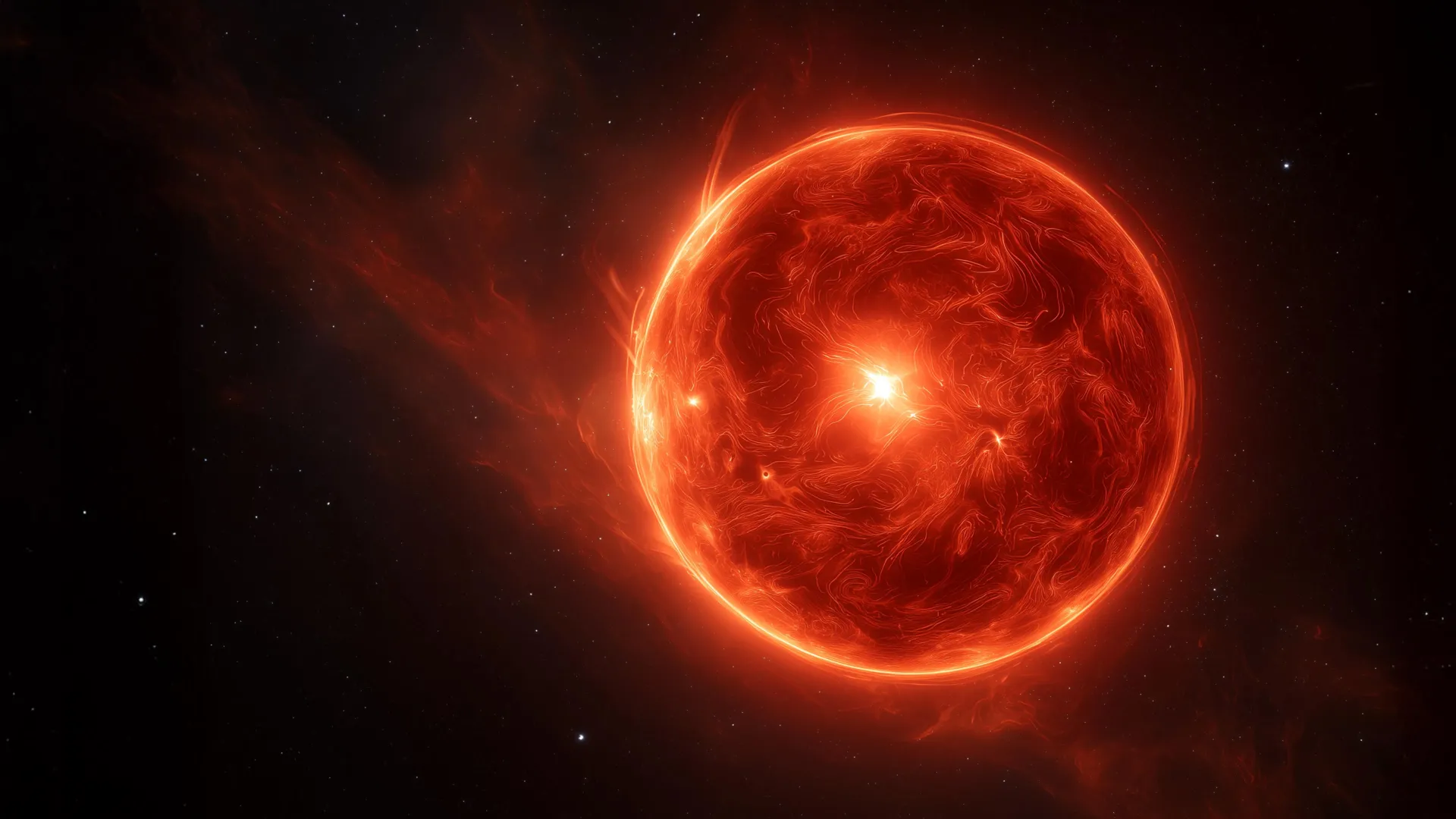
Researchers from the University of Victoria and the University of Minnesota have solved a 50-year-old astronomical mystery regarding red giant stars. Published in Nature Astronomy, the study utilizes high-resolution supercomputer simulations to explain surface chemistry changes. This breakthrough identifies stellar rotation as the primary mechanism for transporting elements across internal stellar barriers.
For decades, scientists struggled to connect deep internal nuclear reactions with observations at the star's outer surface. A stable layer was thought to prevent material from crossing into the convective envelope. The new data shows that rotation amplifies wave activity, allowing material to mix effectively.
Simon Blouin, the lead researcher and postdoctoral fellow at the University of Victoria, stated that rotation provides a natural explanation for observed chemical signatures. He noted that previous simulations found internal waves transported very little material. The new findings demonstrate rotation boosts mixing rates by more than 100 times compared to non-rotating stars.
Astronomers have known since the 1970s that stars like the Sun expand dramatically once they exhaust their core hydrogen. Changes in carbon-12 to carbon-13 ratios suggested deep material transport, but the mechanism remained unconfirmed. This discovery validates long-held hypotheses about stellar evolution and chemical shifts.
Falk Herwig, principal investigator and director of the Astronomy Research Centre, highlighted the role of advanced computing in the study. He explained that limited computing abilities previously prevented quantitative testing of the rotation hypothesis. Researchers accessed resources from the Texas Advanced Computing Centre and the Trillium supercomputing cluster.
Trillium, launched in August 2025, ranks among the most powerful systems available in Canada for large-scale academic simulations. Its enhanced processing capabilities allowed the team to perform the most computationally intensive stellar convection simulations to date. This infrastructure is part of the Digital Research Alliance of Canada.
The methods used in this study extend beyond astrophysics to other fluid motion systems. Herwig is collaborating with researchers to understand ocean currents, atmospheric patterns, and blood flow using similar tools. This cross-disciplinary application underscores the value of high-performance computing infrastructure.
Future work will examine how varying rotation patterns influence mixing efficiency across different types of stars. Blouin plans to explore whether similar processes occur in other stages of stellar evolution. The research received support from the Natural Sciences and Engineering Research Council, the National Science Foundation, and the US Department of Energy.
Understanding these processes provides critical insight into the future evolution of our own Sun. As the Sun eventually becomes a red giant, these models help predict its long-term chemical changes. This knowledge contributes to broader efforts in stellar physics and resource management in the space sector.
The findings mark a significant step forward in understanding how stars evolve and interact with their environments. Continued investment in supercomputing remains essential for solving complex physical conundrums. Analysts will watch for further publications detailing fluid dynamics in non-astrophysical contexts.