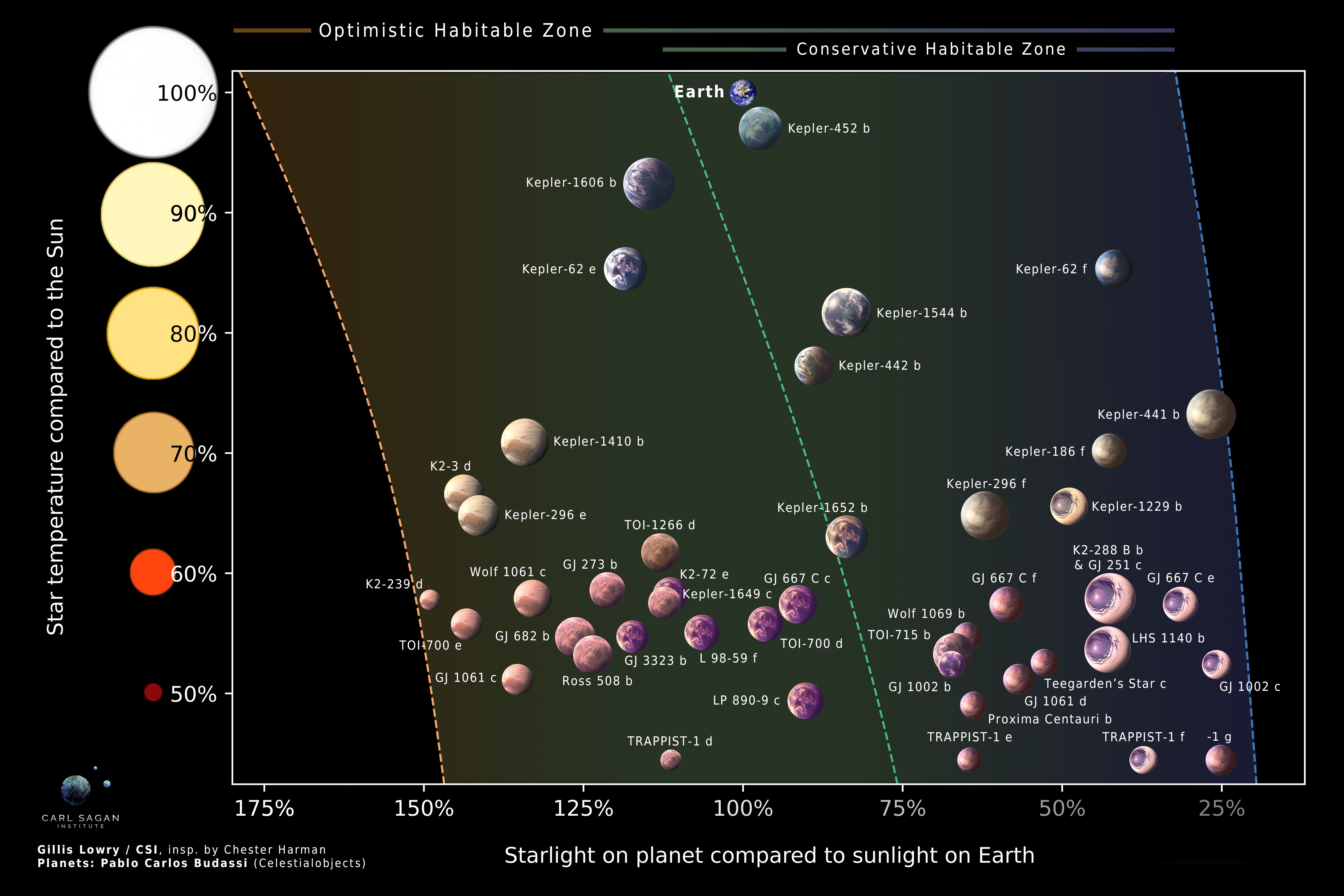
Researchers at Cornell University have identified 45 rocky exoplanets as prime targets for extraterrestrial life. Published in Monthly Notices of the Royal Astronomical Society, the study narrows the search from over 6,000 known worlds. This catalog provides a strategic roadmap for upcoming space telescopes and international missions. The team utilized advanced data processing to filter candidates based on stellar energy levels.
Professor Lisa Kaltenegger led the team using data from the European Space Agency's Gaia mission and the NASA Exoplanet Archive. The researchers defined habitability based on stellar energy levels similar to those received by Earth. They also excluded planets that receive too much radiation to sustain surface water. This rigorous filtering process ensures that future observations focus on the most viable candidates.
Notable entries include the TRAPPIST-1 system, located 40 light-years from Earth, and Proxima Centauri b. The study highlights planets like TRAPPIST-1f and Kepler 186f as top candidates within the standard habitable zone. Another 24 worlds appear in a narrower zone where conditions are even more Earth-like. These specific targets offer the highest probability for detecting biosignatures in the coming decade.
The timing of this research coincides with the release of the Hollywood film Project Hail Mary. Kaltenegger noted that the movie illustrates how life might be more versatile than currently imagined. She stated the paper reveals where humans should travel if they ever built a spacecraft. Public interest in space exploration often drives funding for critical scientific infrastructure projects.
Scientists aim to test the boundaries of habitability using planets at the inner and outer edges of the zone. This data will help refine theories about climate stability and atmospheric retention on distant worlds. Abigail Bohl from Cornell University explained that Earth serves as a reference point for these comparisons. Understanding these limits helps astronomers determine if life requires specific environmental conditions to survive.
Future observational capabilities depend on the James Webb Space Telescope and the Nancy Grace Roman Space Telescope. The Extremely Large Telescope is scheduled to see first light in 2029 to support these ground-based observations. These instruments will determine if the identified worlds can hold atmospheres capable of supporting life. Global cooperation is essential to maximize the scientific return on these expensive technological investments.
The project represents a significant investment in international scientific collaboration and infrastructure. Funding for missions like the Habitable Worlds Observatory is expected to launch in the 2040s. Such large-scale endeavors require coordination between multiple national space agencies and private entities. Economic efficiency dictates that resources be allocated to targets with the highest probability of success.
Identifying specific targets reduces the cost of discovery by prioritizing high-probability candidates for observation. This efficiency is critical as governments weigh the economic return on deep space exploration programs. Gillis Lowry, a graduate student, confirmed she is already using the list to prioritize early observations. Strategic planning ensures that limited budget funds are not wasted on unlikely planetary systems.
The study also considers planets with unusual elliptical orbits to understand heat variations over time. Eccentric orbits may reveal whether a planet can maintain habitability while crossing habitable boundaries. This research challenges previous assumptions about the stability required for life to evolve. New orbital data provides insights into how climate systems react to changing energy inputs.
Ultimately, the catalog serves as a foundational document for the next generation of astrobiology. It guides astronomers on where to focus limited resources to find definitive proof of extraterrestrial biology. The findings mark a strategic shift from discovery to targeted analysis of planetary conditions. This approach defines the future trajectory of humanity's search for life beyond the Solar System.