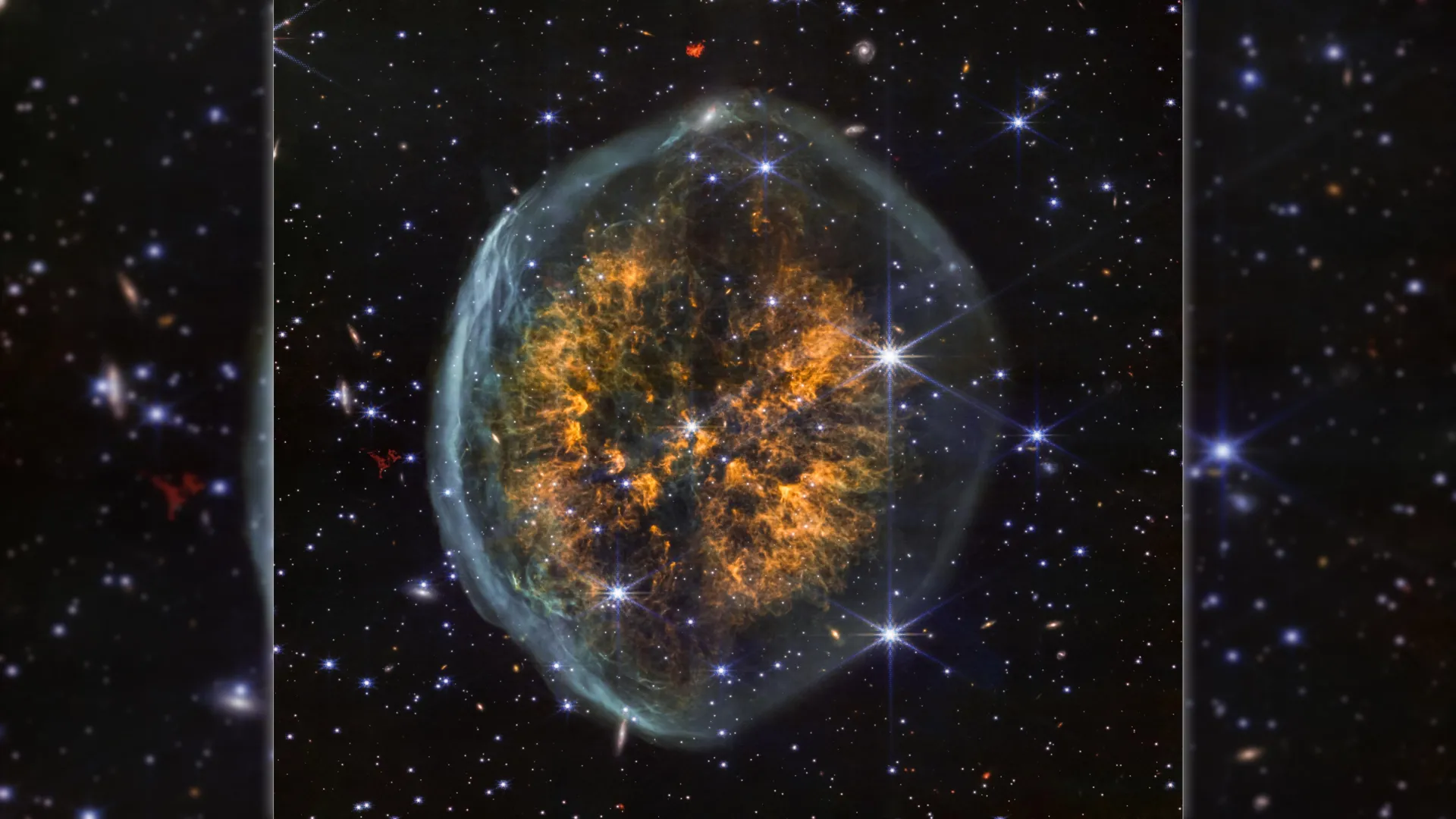
NASA’s James Webb Space Telescope revealed a new image of a dying star nebula on March 17, 2026. The object, officially named PMR 1, displays a unique structure resembling a human brain inside a skull. Scientists at NASA’s Goddard Space Flight Center released the data to public attention today. The announcement highlights ongoing advancements in astronomical imaging technology. This progress is crucial for the next generation of space observatories.
The nebula features a dark central divide that separates distinct gas layers into two hemispheres. This specific configuration has led researchers to nickname the formation the Exposed Cranium nebula. Webb’s infrared capabilities highlight details invisible to previous telescopes. This level of clarity was previously unattainable with older instruments. It allows for precise mapping of the nebula's physical boundaries.
Near infrared and mid infrared instruments captured the layered structure of the cloud. The outer shell consists mostly of hydrogen expelled during earlier stages of stellar evolution. Inner regions show complex mixing of gases and dust particles. These components reveal the chemical history of the star before its death. Such data helps astronomers understand the lifecycle of massive stars.
A vertical dark lane runs through the center of the cloud, suggesting active material flow. Evidence points to powerful jets shooting from the central star driving this structure. High resolution imaging shows gas being pushed outward near the top of the nebula. Such dynamics are critical for understanding mass loss in late stellar phases. Jets often dictate the final shape of the ejected material.
The star forming this nebula is nearing the end of its fuel-burning life cycle. Depending on its mass, the remnant could become a supernova or a white dwarf. This snapshot captures a brief and dramatic phase in cosmic history. The exact mass remains uncertain and requires further spectral analysis. Future observations may resolve the specific evolutionary path of the star.
Webb represents the most advanced space observatory ever constructed for studying the universe. It operates as an international collaboration led by NASA with partners from Europe and Canada. This partnership demonstrates significant investment in deep space research capabilities. Joint efforts allow for shared risk and distributed scientific responsibility. This model encourages broader participation in high-cost scientific endeavors.
Funding for the mission involves contributions from multiple government space agencies globally. Such cooperation reduces costs while maximizing scientific return on billions of dollars invested. It sets a precedent for future international mega-projects in space exploration. Economic efficiency is a primary driver behind these complex alliances. Cost sharing ensures that no single nation bears the full financial burden.
Analysts note that such collaboration stabilizes space policy among major economic powers. Continued monitoring may reveal how stellar death impacts the surrounding interstellar medium. The data will inform models for future telescope missions. Strategic partnerships help maintain a stable environment for long-term scientific goals. Geopolitical stability in space is increasingly reliant on these frameworks.
This discovery adds to the growing catalog of planetary nebulae mapped by modern instruments. Previous data from the Spitzer Space Telescope provided a baseline for comparison. Webb offers a much sharper view of these distant objects. Comparing data across decades improves the accuracy of cosmic models. Long-term datasets are essential for verifying theoretical predictions.
The findings underscore the value of sustained international funding for astrophysics. Future missions will rely on similar collaborative frameworks to explore the cosmos. La Era will continue tracking developments in space science. Continued investment ensures humanity maintains a presence in the frontiers of knowledge. Long-term funding strategies are critical for sustaining this progress.