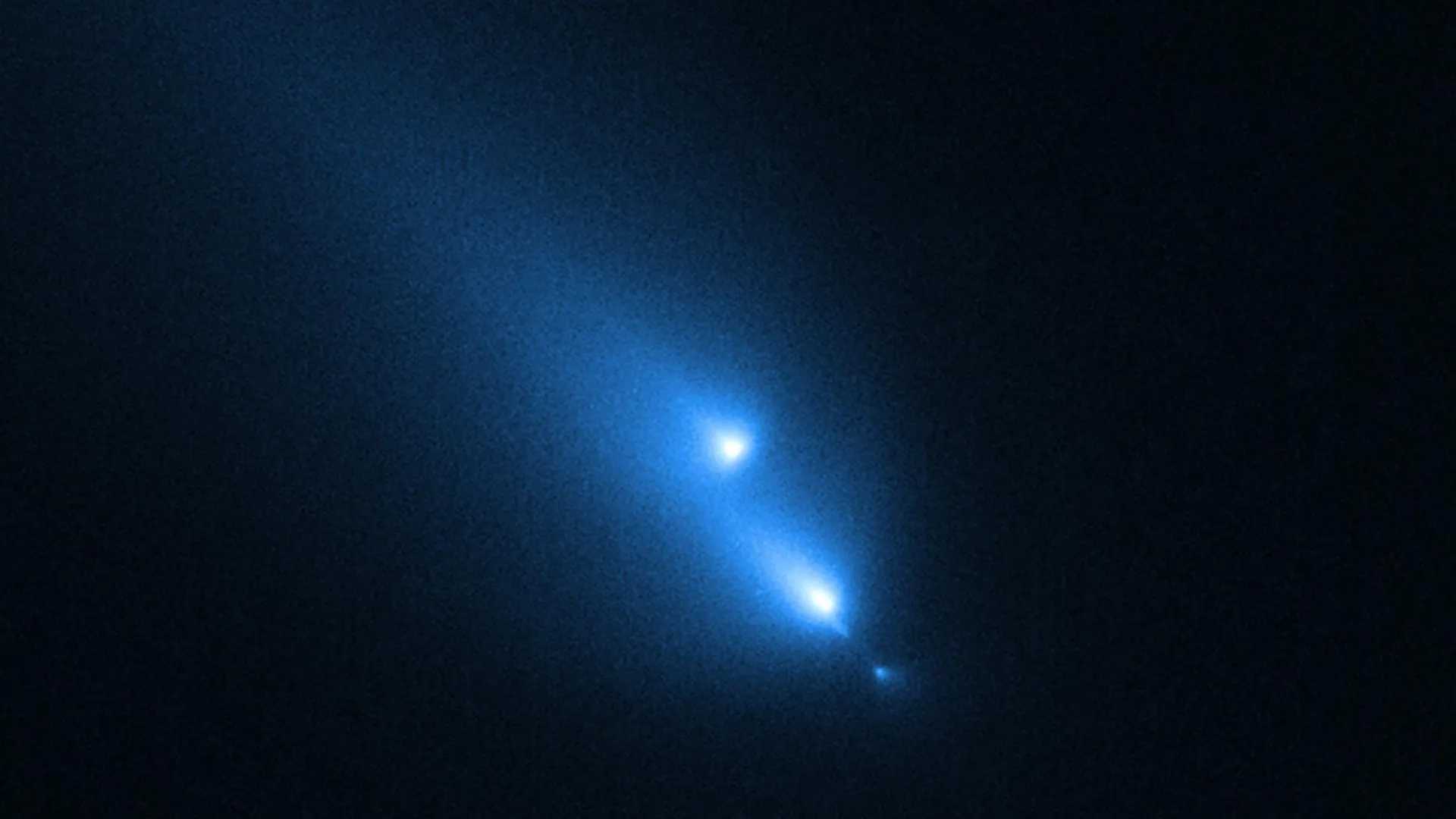
NASA's Hubble Space Telescope accidentally captured a comet fragmenting in real time during a routine observation window in November 2025. The telescope identified Comet K1, formally designated C/2025 K1 (ATLAS), disintegrating within the inner solar system near Mercury. This rare visual evidence was published recently in the peer-reviewed journal Icarus by the research team. The event provided unprecedented clarity on the structural integrity of icy bodies traveling close to the star. This finding marks a significant milestone for planetary science researchers seeking to understand comet dynamics.
The discovery occurred while astronomers were attempting to observe a different target due to unexpected technical constraints preventing the original plan. Co-investigator John Noonan from Auburn University noted that the best science often happens by accident in unpredictable ways. They had submitted multiple proposals to observe such an event with Hubble, but timing these observations has proven extremely difficult. The team realized the anomaly only after reviewing the high-resolution image data the following morning carefully.
Principal investigator Dennis Bodewits described the situation as ironic given their long struggle to time such an event successfully before. Previous proposals to capture a comet breakup had failed due to the extreme difficulty of predicting the exact moment of disintegration. Now the team studies a standard comet simply because it crumbled in front of their sensitive instruments unexpectedly. Comets are leftovers of the era of solar system formation, so they are made of old primordial materials.
Hubble resolved at least four distinct fragments, each surrounded by its own coma of gas and dust clouds expanding outward. Ground-based telescopes could only detect these pieces as faint, barely separated points of light against the dark sky background. The high resolution allowed researchers to trace the fragments backward to reconstruct the original single object accurately. This data helps distinguish between primitive properties and those due to evolutionary heating processes.
Breakup timing coincided with the comet's perihelion, occurring about a month after closest approach to the Sun and intense heat. During this phase, K1 traveled inside Mercury's orbit to endure the most intense heat and stress from direct solar radiation. Many long-period comets tend to begin breaking apart shortly after this specific solar exposure period concludes. Scientists estimate the breakup started around eight days before Hubble captured the images.
Analysis revealed an unexpected puzzle regarding the delay between physical breakup and bright outbursts observed from Earth recently. Fresh ice exposure should theoretically cause immediate brightness, yet the comet remained faint initially for several days without change. Scientists propose that a dry dust layer must form and blow off before significant gas release occurs visibly. This indicates the timescale it takes to form a substantial dust layer that can then be ejected by the gas.
Early observations suggest K1 possesses an unusual chemical makeup with significantly lower carbon levels than most comets in the system. Additional data from Hubble's STIS and COS instruments will provide deeper insight into this unique composition and origins. Such data helps determine if the material represents primitive properties or evolved surface conditions from heat. Researchers expect to find answers regarding why carbon levels are so low compared to typical comets.
The research team plans to continue analyzing gases released by the comet cluster located 250 million miles from Earth currently. K1 is moving away from the Sun and likely will never return to the inner solar system again in its lifetime. This joint project between NASA and the European Space Agency continues to deliver critical discoveries about the universe. Scientific operations are conducted by the Space Telescope Science Institute in Baltimore.