A large meteor descended through the sound barrier above northern Ohio on Tuesday morning, producing a significant fireball. The event was visible across a wide area including parts of neighboring states, according to reports filed by Arstechnica. Local officials have confirmed no immediate impacts on the ground as of mid-morning, though recovery teams remain on standby.
Eyewitnesses described the bright streak lighting up the morning sky before the sound arrived. Residents characterized the noise as an extremely loud boom that shook windows in the vicinity. These accounts match the typical timeline for hypersonic atmospheric entry events where light precedes sound.
Jared Rackley, a National Weather Service meteorologist based in Pennsylvania, captured video of the passage. He documented the object traversing the atmosphere and generating a large fireball in daylight conditions. This visual evidence supports the data collected by orbital sensors and assists in triangulating the trajectory.
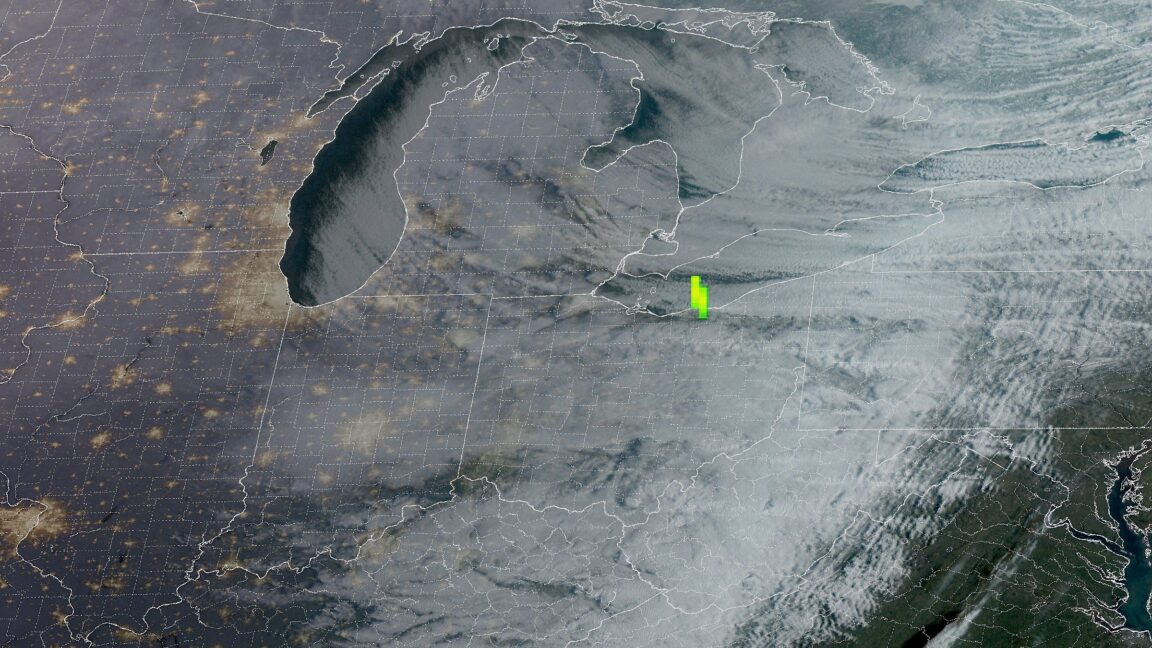
A near-infrared optical detector on a geostationary satellite pinpointed the location of the fireball at 9:01 am ET. The Geostationary Lightning Mapper revealed the object moved over Lake Erie and just west of Cleveland. This satellite technology is often used for storm monitoring but also tracks high-energy light flashes from the sky.
A meteoroid becomes a meteor when it encounters a planet atmosphere and produces a bright streak of light. In this case, the object traveled many times faster than the speed of sound through the air. The resulting sonic boom was caused by a powerful shockwave from hypersonic movement compressing the surrounding gas.
This shockwave compresses the air and creates a rumbling sound heard by populations below the trajectory path. Unlike a supersonic aircraft, the meteor generated noise through atmospheric friction and pressure changes during descent. The phenomenon explains why the sound was perceived as a continuous rumble rather than a single crack.
Such events are monitored closely to assess potential risks to infrastructure and public safety in the region. Previous meteors have been tracked without causing significant damage to populated areas or critical facilities. Authorities rely on this historical context to evaluate the current incident severity and response protocols.
No further information regarding the size or composition of the meteor was available by mid-morning on Tuesday. Reports of ground impacts remain unconfirmed as teams review seismic and acoustic data from nearby stations. Updates are expected if additional findings emerge from the monitoring networks and automated sensors.
The detection highlights the effectiveness of current space weather and atmospheric monitoring systems across the globe. Government agencies utilize this data to refine models for potential hazardous objects that might threaten civilization. Enhanced visibility helps communities understand the frequency of near-Earth encounters and prepares them for future events.
Observers will watch for subsequent reports on any debris field or recovery efforts in the Lake Erie area. The National Weather Service plans to release a formal statement once the investigation concludes and evidence is verified. Public interest remains high regarding safety implications for the Ohio Valley region and surrounding states.