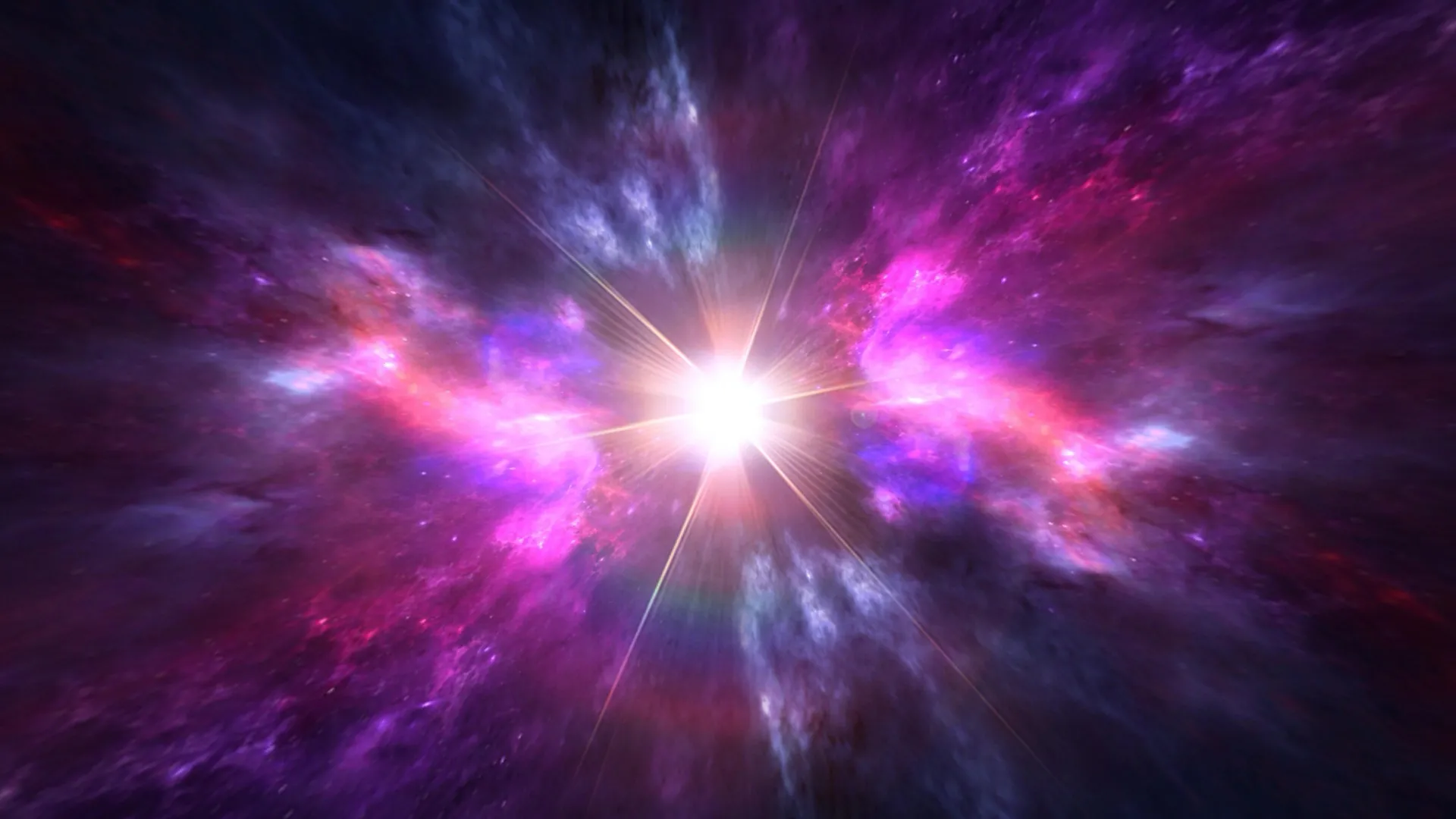
Astronomers have identified a rare supernova from 10 billion years ago that may unlock secrets about dark energy. The discovery was announced on March 16, 2026, by researchers at Liverpool John Moores University. This event offers a unique opportunity to measure the universe's expansion speed with high precision.
The light from this explosion traveled more than 10 billion years before reaching Earth. It was exceptionally bright and further amplified by the gravity of a galaxy along the line of sight. This magnification allowed medium-sized ground-based telescopes to detect the event despite its enormous distance.
A galaxy positioned directly between Earth and the supernova plays a crucial role in the observation. Its gravitational pull bends the light traveling from the explosion toward observatories here. We are seeing the light from this distant supernova split into multiple images, a phenomenon known as gravitational lensing.
Dr. Daniel Perley, a reader in astrophysics at Liverpool John Moores University, stated that no one has found a supernova like this before. He explained that the nature of the system may help solve big problems in astrophysics. The team hopes these findings clarify the force driving the expansion of the universe.
Because light follows different paths, it arrives at Earth at different times. Astronomers can observe multiple images of the same explosion at once while it shines for several months. The amount of time difference between images depends on the expansion rate of the universe.
Astronomers currently face a major puzzle regarding the universe's expansion rate known as the Hubble Tension. Different methods produce conflicting values for the Hubble constant used to describe cosmic speed. Perley believes observations of this unusual supernova could help resolve the disagreement.
The Zwicky Transient Facility in California detected the object, but the Liverpool Telescope in La Palma proved it was lensed. Later studies utilized the Keck Telescopes in Hawaii and space-based instruments like the Hubble Space Telescope. The James Webb Space Telescope also contributed to the detailed analysis of the event, showcasing international technological cooperation.
The research team included collaborators at Caltech, Stockholm University, and other institutions around the world. Their study was published in the journal Astrophysical Letters under the title Discovery of SN 2025wny. The paper lists 24 co-authors alongside the lead researchers, highlighting the global scale of the effort.
The team plans to measure these time delays with high precision to reveal the expansion history. Those measurements could provide insight into the force responsible for accelerating that expansion. This data may indicate which of the two conflicting Hubble constant numbers we should believe.