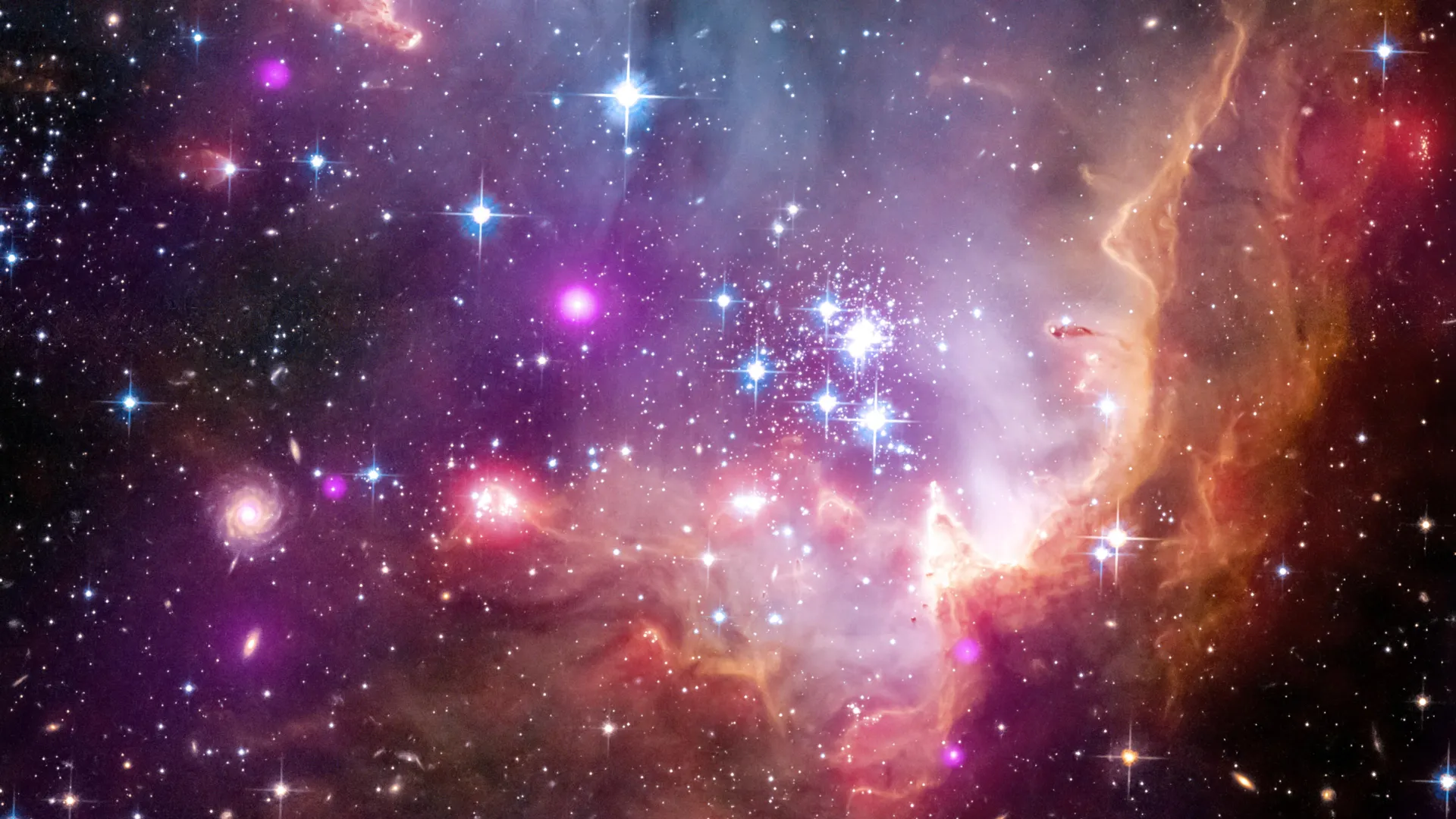
Scientists at the University of Arizona have determined that the Small Magellanic Cloud was shattered by a cosmic crash millions of years ago. This discovery resolves long-standing puzzles regarding the chaotic movement of stars within this nearby galaxy. The findings were published in The Astrophysical Journal on March 20, 2026, offering a definitive explanation for decades of confusion. The report was featured on ScienceDaily. The team analyzed complex data sets.
The research team identified a direct collision between the Small Magellanic Cloud and its larger neighbor, the Large Magellanic Cloud, as the primary cause. Gravitational forces from this event disrupted the structural integrity of the smaller galaxy during its orbit around the Milky Way. This interaction occurred several hundred million years ago according to the detailed data analysis. Data confirmed the trajectory.
Previously, astronomers observed that the stars did not move in orderly orbits as expected for typical spiral systems. Instead, the stellar motion appeared disorganized and chaotic compared to the Milky Way. This anomaly had remained an unresolved mystery for decades until the new analysis provided clarity. Previous models failed to account for the impact.
The study also clarifies a contradiction regarding the gas content within the galaxy. Measurements previously suggested the gas was rotating, yet the stars did not match this motion. The new model indicates the apparent rotation was an illusion caused by the galaxy stretching during impact. This resolves the inconsistency.
Himansh Rathore, the lead author and graduate student at Steward Observatory, described the event as a live transformation. He stated that the Small Magellanic Cloud provides a unique view of a process critical to galactic evolution. This perspective allows researchers to observe cosmological dynamics in real time. He emphasized the significance.
Historically, the Small Magellanic Cloud served as a key reference point for studying how galaxies form stars. Its high gas content and low metal abundance made it a standard comparison for early universe conditions. However, the discovery of its violent past challenges its reliability as a typical benchmark. This shifts the scientific baseline.
The research team utilized detailed computer simulations to match the known properties of both interacting galaxies. These models accounted for stellar mass, gas content, and positions relative to the Milky Way. The analysis combined theoretical calculations with new techniques to interpret scrambled stellar motions. Simulations matched observations.
The impact may also provide new insight into the distribution of dark matter in the region. A separate study found that the collision left a visible mark on the Large Magellanic Cloud structure. This relationship offers a method to estimate dark matter through gravitational influence. New data supports this theory.
Astronomers are accustomed to viewing the cosmos as a static snapshot in time. These two galaxies have moved through one another and transformed into something entirely different. Future observations will likely refine the timeline of this ongoing cosmic evolution. Further study is required.