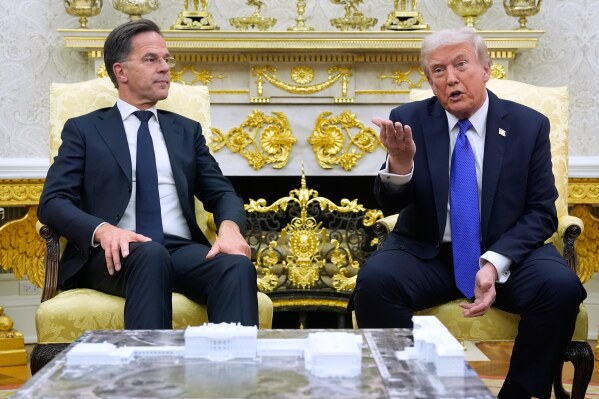
President Donald Trump and NATO Secretary General Mark Rutte held a private meeting at the White House on Wednesday, a session centered on the president’s repeated threats to withdraw the United States from the organization.
White House Press Secretary Karoline Leavitt confirmed the agenda prior to the meeting. “The withdrawal of the United States from the Atlantic Alliance is a matter that the president has addressed, and I believe it is something he will discuss with Secretary General Rutte,” Leavitt told reporters during her weekly briefing.
The meeting, which lasted approximately two hours, followed a period of escalating tension between Trump and the alliance. The president has publicly attacked several NATO members, labeling them “cowards” and describing the organization as a “paper tiger.”
Friction over military support
Trump’s criticism stems from what he characterizes as a lack of support for U.S. operations against Iran. He has specifically rebuked allies for closing their airspace to American aircraft, denying access to military bases, and refusing to deploy naval vessels to the Strait of Hormuz to secure maritime traffic.
These hostilities took place despite a recent two-week ceasefire agreement between Washington and Tehran. That deal successfully reopened the Strait of Hormuz, a critical transit point for a significant portion of global hydrocarbon exports.
Despite the president’s rhetoric, a formal withdrawal from NATO faces significant legal obstacles. Any attempt to exit the alliance requires congressional approval, a hurdle Trump currently lacks the political support to clear.
The legislative landscape is complicated by a 2023 law, sponsored by then-Senator Marco Rubio. Rubio, who now serves as Secretary of State, helped craft the measure that requires a two-thirds vote in the Senate for the United States to withdraw from the treaty.
Neither the White House nor NATO representatives provided details on the specific outcomes of Wednesday's two-hour session. The encounter marks the latest attempt to bridge a widening gap between Washington and its traditional European partners.