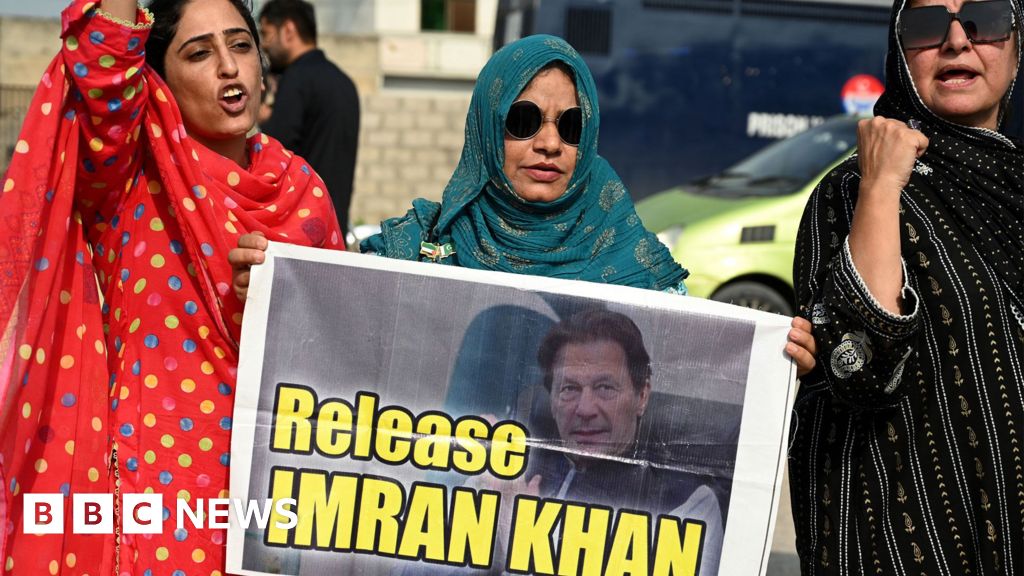
Pakistan's jailed former Prime Minister Imran Khan has reportedly been denied visitors for over five weeks, a move his party attributes to efforts by the military establishment to suppress his external communications. The government counters that the restrictions stem from Khan violating prison regulations prohibiting political discussion, according to reports cited by the BBC.
This restriction on Khan's access coincides with a broader tightening of civil liberties across the nation, impacting journalists, analysts, and human rights advocates. Human rights lawyer Imaan Mazari and her husband recently received ten-year sentences for sharing anti-state social media content, highlighting the escalating risks associated with dissent.
Khan's sister, Aleema Khanum, stated that public discourse is now effectively controlled, noting that media outlets avoid mentioning Khan favorably or criticizing Field Marshall Asim Munir, the military chief. Khan, imprisoned since August 2023 on corruption charges he deems politically motivated, has used jail meetings to disseminate critical messages via his X account.
Following a post quoting Khan labeling Munir as mentally unstable, the military spokesperson publicly categorized Khan as a national security threat, intensifying the government's stance against him. Michael Kugelman of the Atlantic Council suggested this repression indicates Pakistan is approaching authoritarian rule, marking the worst period of suppression under civilian government.
Analysts link the reduced space for free expression directly to the military's perceived dominance in political affairs, a dynamic that intensifies when civilian authority is perceived as weak. Munizae Jahangir, co-chair for the Human Rights Council of Pakistan (HRCP), noted that increased military influence invariably curtails public protest and free expression.
Journalists report significant pressure, including directives against showing Khan's image or voice on television, with self-censorship becoming common practice in newsrooms to ensure survival. Geo TV reporter Azaz Syed confirmed receiving warnings for covering stories tangentially related to the military, such as one concerning a defence housing authority.
Financial measures have also been deployed against critical media organizations; Dawn Media Group reported an unannounced ban on government advertisements, which the organization deemed financially crippling. While the Information Minister denied targeting Dawn, the action underscores the state's capacity to exert economic pressure on non-compliant outlets.