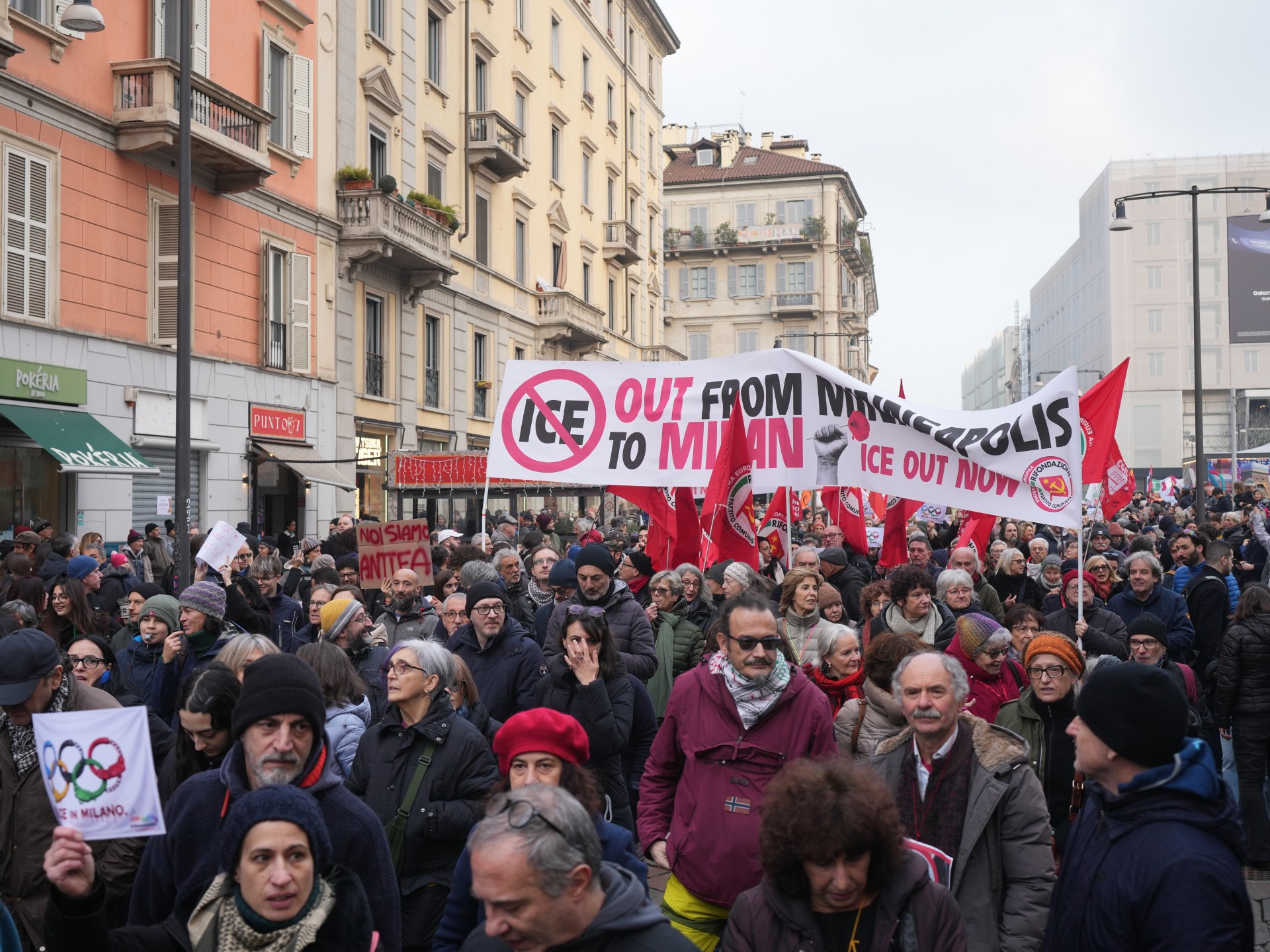
Hundreds of demonstrators gathered in Milan on Saturday to protest the planned deployment of US Immigration and Customs Enforcement (ICE) agents during the upcoming Milano-Cortina 2026 Winter Olympics. The protest, held in Piazza XXV Aprile—a site commemorating Italy’s liberation from Nazi fascism in 1945—drew support from left-leaning political parties, major trade unions like CGIL, and ANPI organizations, according to reports.
Organizers emphasized that the opposition targeted the symbolic presence of the US delegation’s security detail, viewing it as an endorsement of perceived authoritarian trends in the United States. Protest banners reportedly referenced human rights concerns and drew parallels to historical oppression, with one sign comparing ICE to the Gestapo.
While ICE officials stated that the agents assigned would be from Homeland Security Investigations (HSI) and focused on cross-border crime within a control room, demonstrators remained unconvinced. Protesters noted that even a limited investigative role was unacceptable in Italy, a nation emphasizing its peaceful character.
Milan Mayor Giuseppe Sala publicly stated that the ICE agents were not welcome in the city, escalating the domestic political fallout. Furthermore, Italian Interior Minister Matteo Piantedosi has reportedly been summoned to Parliament for testimony regarding the security arrangements this week.
The distinction between HSI, which handles transnational investigations, and Enforcement and Removal Operations (ERO), which spearheads domestic immigration crackdowns, appears irrelevant to the demonstrators. Participants maintained that the philosophical implications of having any ICE component present outweighed the technical clarification of their duties.
The geopolitical optics are complicated by the scheduled attendance of high-ranking US officials, including Vice President JD Vance and Secretary of State Marco Rubio, at the opening ceremony on February 6.
The controversy underscores a sensitive political dynamic between European allies and the US regarding domestic security practices and international cooperation during major global events. The incident reflects broader international scrutiny over US immigration enforcement policies.