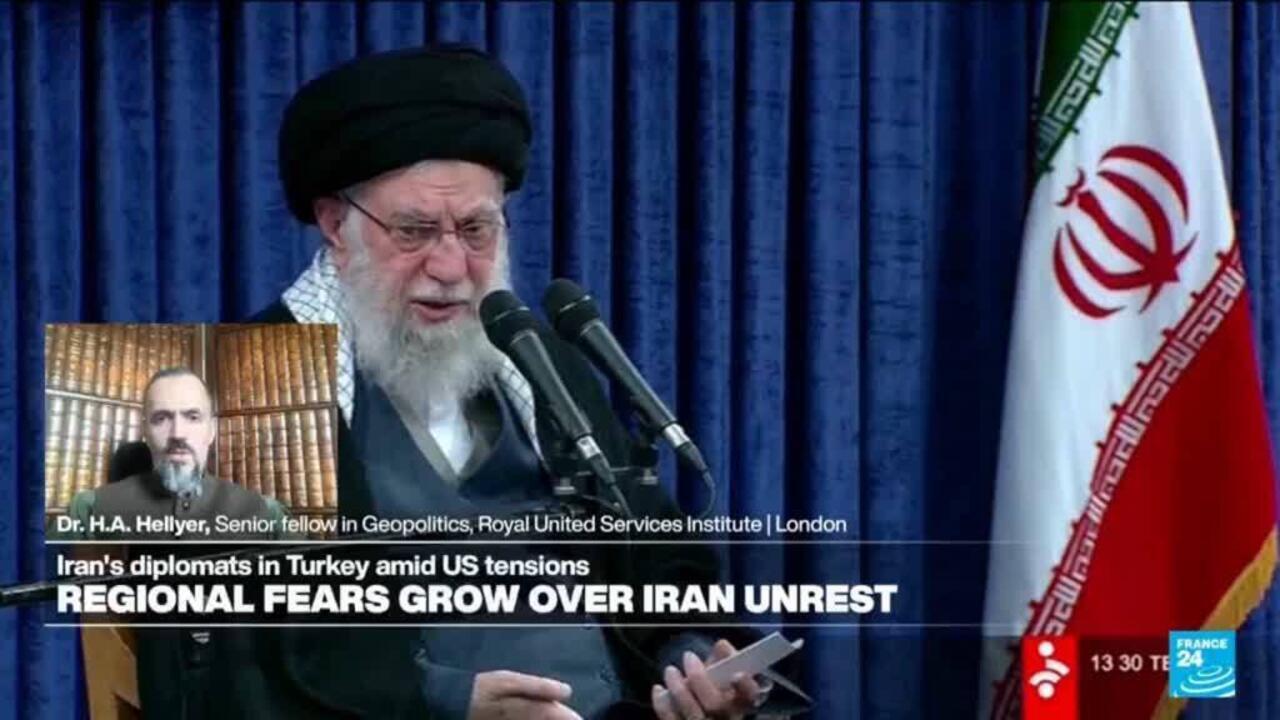
Dr. H. A. Hellyer, Senior Associate Fellow at the Royal United Services Institute for Defence and Int'l Security Studies, indicated that achieving meaningful political reform in Iran is strategically equivalent to acknowledging the end of the Islamic Revolution. This assessment frames the internal political dynamics against a backdrop of significant external geopolitical pressure.
According to analysis published by France 24 on January thirtieth, Dr. Hellyer highlighted the inherent strategic limitations constraining Tehran's ability to open its political system substantially. Such changes, he posits, would fundamentally contradict the foundational principles established by the revolution decades ago.
The expert detailed broader regional instability, noting the ambivalence among Gulf states regarding potential military escalation in the current climate. This caution contrasts with heightened tensions in the Middle East, creating a delicate security equilibrium.
Furthermore, the regional environment is characterized by significant uncertainty stemming from the highly unpredictable foreign policy posture of the sitting U.S. President. This unpredictability complicates long-term strategic planning for regional actors, including Iran and its neighbors.
Diplomacy in this environment is described as both urgent due to the instability and elusive due to maximalist demands from various parties. These demands often clash with the need to manage regional power realignments currently underway.
Fears surrounding potential post-regime chaos also contribute to the cautious approach taken by international players observing Iranian internal politics. The risk of systemic collapse discourages aggressive diplomatic or military maneuvers, according to the report.
Dr. Hellyer's observations underscore the deep-seated structural obstacles preventing fundamental liberalization within the Iranian political structure. These constraints prioritize ideological continuity over immediate political concessions.
The convergence of internal rigidity and volatile external factors suggests that near-term stability in the region remains contingent upon managing these complex, overlapping geopolitical risks.