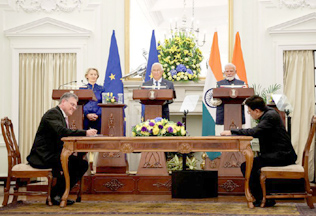
The European Union and India have formalized a major strategic partnership, encompassing both a comprehensive free trade agreement (FTA) and a security and defense pact, according to reports following the high-profile summit in New Delhi. This security agreement marks only the third of its kind for the EU, following similar arrangements with Japan and South Korea, sending a clear signal regarding shifting global alliances.
This deepening engagement occurs as both Brussels and New Delhi seek to mitigate risks associated with escalating trade tensions, particularly punitive tariffs imposed by the United States. India is actively diversifying its export markets, while the EU appears focused on reducing its economic reliance on the US, a dynamic underscored by recent statements at the World Economic Forum in Davos.
Merchandise trade between the two blocs reached $136 billion in the 2024-2025 fiscal year, positioning the EU as India's largest trading partner, surpassing the $132 billion recorded with the US. Despite this substantial economic reality, the media focus often centered on US trade friction, largely due to Washington's assertive use of trade policy as a foreign policy instrument.
The path to this agreement was protracted, with FTA negotiations spanning 18 years and facing suspensions in 2014 before resuming in 2022, reflecting historical rigidity on both sides. Analysts suggest that maintaining momentum will require compromises on issues such as the European Commission’s complex regulatory framework, which has historically deterred deeper investment flows compared to China.
Immediate friction points center on non-tariff barriers, prominently the EU's Carbon Border Adjustment Mechanism (CBAM), which threatens to raise costs for key Indian exports like steel and cement. Data cited by UNCTAD suggests the CBAM's climate impact is marginal, positioning it as a significant non-tariff barrier that counters India's market access demands.
Furthermore, India is pressing for greater mobility pathways for skilled professionals, recognizing the economic advantage enjoyed by the US through relaxed entry policies for highly educated personnel. While a new mobility agreement is reportedly underway, its focus remains primarily on students and researchers, leaving concerns over high-tech talent migration unresolved.
Sustaining the current diplomatic warmth, which facilitated the recent agreement, necessitates a mutual reduction in bureaucratic red tape which both entities are known for, as noted by observers familiar with the negotiations. The success of this strategic upgrade in the context of a transforming world order will hinge on the resolve shown in dismantling these long-standing structural impediments.