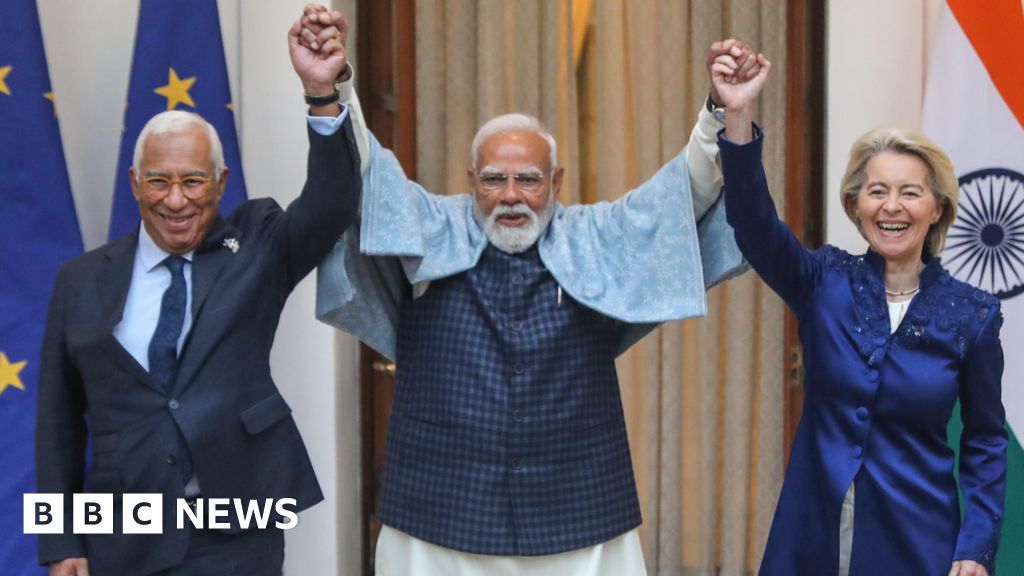
EU-India Seal Historic Trade Deal Amid Rising US Tariff Pressures
After nearly two decades of negotiations, the European Union and India finalize a landmark free trade agreement covering 25% of global GDP, as both blocs seek alternatives to US trade tensions.
EU-India Seal Historic Trade Deal Amid Rising US Tariff Pressures
The European Union and India have concluded a historic free trade agreement after nearly two decades of intermittent negotiations, marking a significant geopolitical shift as both economic blocs navigate escalating trade tensions with the United States.European Commission President Ursula von der Leyen, speaking at a media briefing in New Delhi, declared the achievement "the mother of all deals," while Indian Prime Minister Narendra Modi characterized the pact as "historic." The agreement creates a unified market encompassing 2 billion consumers and representing nearly 25% of global gross domestic product.The comprehensive trade deal eliminates substantial tariffs across multiple sectors. Motor vehicle duties, currently reaching 110%, will be reduced to 10% under a quota system allowing 250,000 vehicles annually—six times larger than India's recent agreement with the United Kingdom. European exports of chemicals, machinery, electrical equipment, aircraft, and spacecraft will benefit from phased tariff eliminations, while Indian textiles, leather goods, marine products, handicrafts, gems, and jewelry will gain preferential access to European markets.The agreement's timing reflects broader geopolitical realignments. Both parties face economic pressure from Washington, with India confronting 50% tariffs imposed by President Donald Trump, while the EU contends with threatened escalations in trade disputes. European Council President António Costa emphasized that the deal sends "an important political message to the world that India and the EU believe more in trade agreements than in tariffs."Beyond trade liberalization, the agreement includes provisions for professional mobility between regions and establishes frameworks for security and defense cooperation. Indian Defense Minister Rajnath Singh announced discussions on supply chain integration and defense ecosystem development with European Commission Vice-President Kaja Kallas.Economic analysts project significant benefits for labor-intensive Indian sectors previously impacted by US tariffs, including shrimp farming and textile manufacturing. However, economist Mitali Nikore warns of compliance challenges with stringent EU environmental regulations and carbon offsetting mechanisms, noting that India's manufacturing sector "might not be fully prepared" for these standards.For European stakeholders, particularly Germany and France, the agreement provides economic certainty amid global turbulence. Andrew Small, Asia Director at the European Council on Foreign Relations, describes the deal as "a floor for what is possible for the bilateral relationship" rather than a final destination, positioning it as a building block for deeper integration with Asia's fastest-growing major economy.The formal signing awaits approval from the European Parliament and member states, expected later this year. Unlike the recently stalled EU-Mercosur agreement, analysts consider the India deal less contentious due to its careful navigation of sensitive sectors on both sides.Current bilateral merchandise trade between the EU and India reached $136 billion in 2024-25, nearly doubling over the past decade, with the EU serving as India's largest trading partner in goods. The agreement represents India's most significant free trade deal to date, complementing recent pacts with the UK, Oman, New Zealand, and the European Free Trade Association.According to BBC reporting, EU diplomatic sources acknowledged that Trump's tariff policies provided "useful tailwind in the homestretch" to finalize negotiations, underscoring how US trade policies are reshaping global economic alliances and accelerating alternative partnership formations.