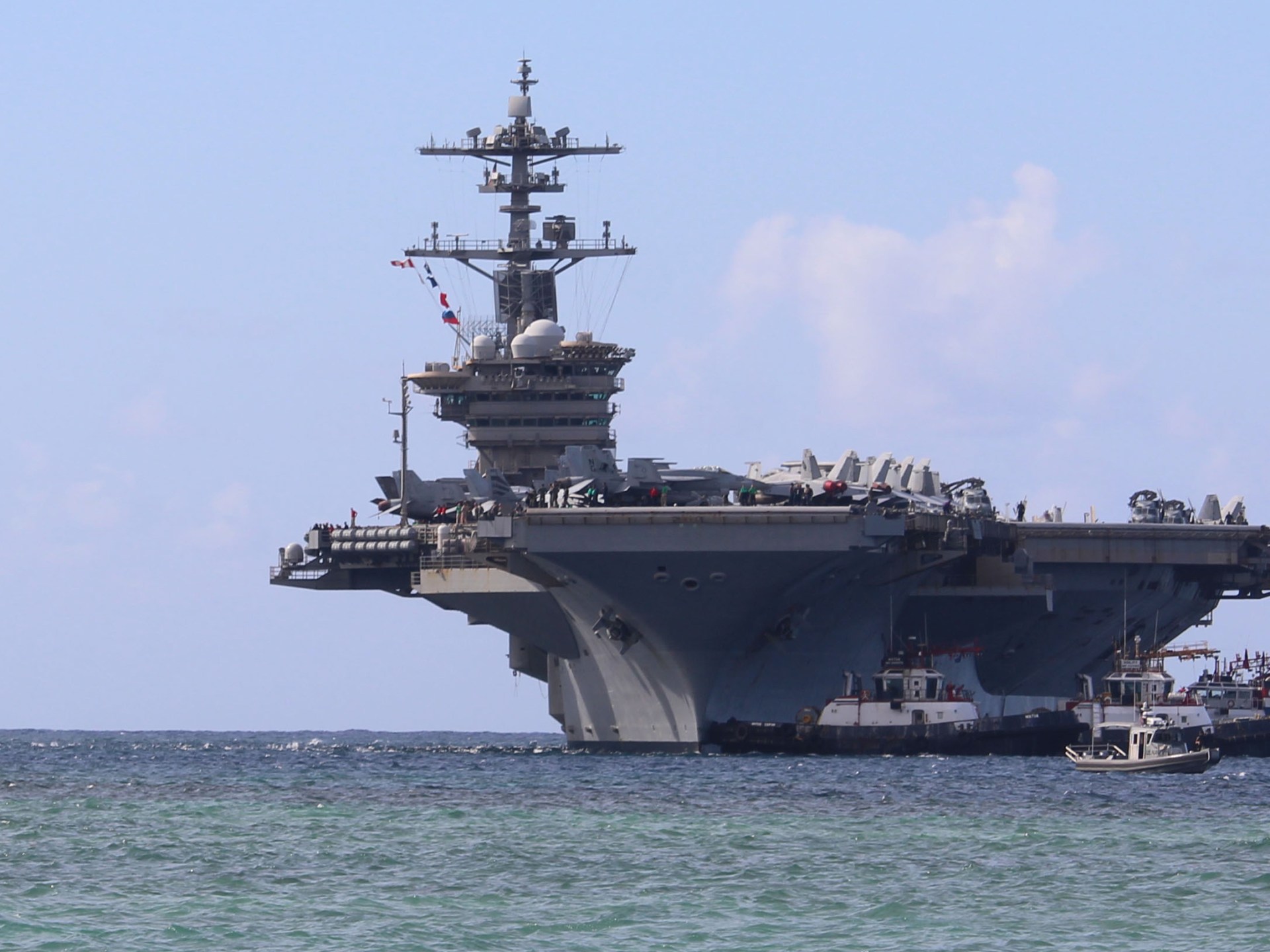
Recent movements by the United States military in the Arabian Sea, notably the repositioning of the nuclear-powered aircraft carrier USS Abraham Lincoln, suggest an intensification of operational readiness near Iranian airspace. This mobilization is being closely scrutinized by international observers, drawing direct parallels to the force posture preceding the significant 12-day Iran-Israel War of June 2025, which saw coordinated US strikes against three key Iranian nuclear sites.
The context for this renewed tension is rooted in domestic instability within Iran, where widespread protests over economic collapse—initially focused on currency depreciation—have reportedly morphed into calls for regime change. Allegations of severe crackdowns and high casualty counts among demonstrators have elicited sharp condemnation from the White House, with President Donald Trump issuing explicit military threats should Tehran proceed with executions of detained protesters.
While President Trump recently indicated a temporary de-escalation following assurances from Tehran regarding the halt of executions, the simultaneous military positioning suggests contingency planning remains paramount. The President confirmed the deployment of a 'massive fleet' to the region, cautioning that any future action, should threats materialize, would eclipse the scale of the 2025 nuclear site attacks.
CENTCOM confirmed the deployment of the USS Abraham Lincoln, one of the Navy’s largest warships, citing a mandate to 'promote regional security and stability.' Simultaneously, US Air Forces Central Command (AFCENT) initiated multi-day readiness drills across its Area of Responsibility, designed to calibrate rapid asset deployment and bolster partner nation interoperability. These maneuvers underscore an established pattern of force projection aimed at deterring regional actors, including Houthi forces targeting Red Sea commerce.
For context, the June 2025 strikes, codenamed Operation Midnight Hammer, involved a complex air and sub-surface operation targeting Fordow, Natanz, and Isfahan. The assault utilized specialized ordnance, including the GBU-57 Massive Ordnance Penetrators (MOPs) against the deeply buried Fordow facility, demonstrating a high-level commitment to degrading Iran’s nuclear infrastructure. Iran’s subsequent, largely symbolic, strike on the US base in Qatar highlighted the retaliatory calculus of the prior conflict.
The current Carrier Strike Group 3 formation, spearheaded by the USS Abraham Lincoln and supported by Arleigh Burke-class destroyers, represents significant mobile airpower, capable of deploying Carrier Air Wing 9 assets like the F/A-18E Super Hornet. The presence of such high-value, long-endurance assets suggests Washington is maintaining maximal credible deterrence capabilities in the immediate proximity of the Persian Gulf.
Analysts note that the strategic calculus remains fragile. The deployment patterns observed now bear a striking resemblance to the lead-up to the 2025 kinetic exchange, suggesting that the threshold for military engagement remains low, heavily contingent on the internal political trajectory within Iran and the adherence to diplomatic off-ramps secured by the US.
This development serves as a critical indicator of the geopolitical volatility surrounding the Persian Gulf, where internal dissent can rapidly converge with external military posturing to redefine regional security dynamics. (Source: Al Jazeera reporting, January 2026)