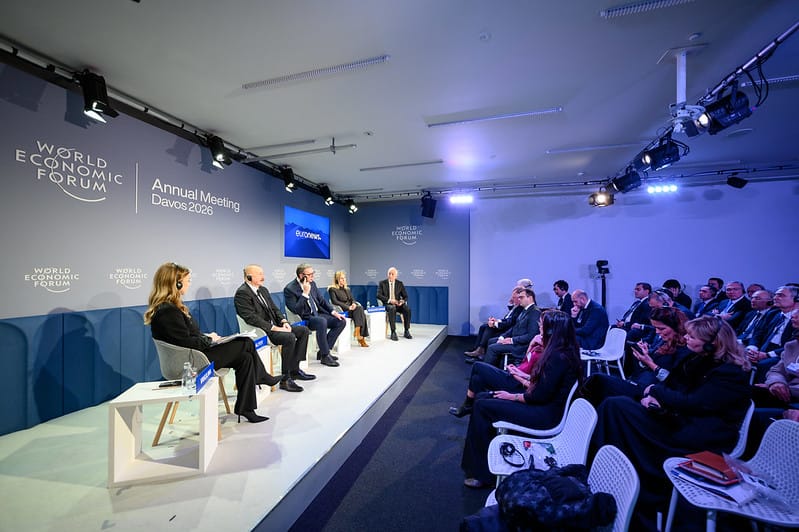
The recent gathering of global economic and political figures in Davos underscored a critical inflection point: the tacit admission that established Western-led institutions are facing systemic failure. While official rhetoric focused on incremental adjustments, the underlying discourse pointed toward an urgent scramble to construct replacement architectures capable of managing the fallout from decades of financial engineering.
This emergent crisis is framed by analysts as a fundamental breakdown of the physical economy, increasingly subordinated to an expanding financial speculation bubble. Drawing parallels to historical systemic collapses, the current situation is characterized by an unsustainable leverage ratio, estimated to have reached $2.4 quadrillion—a significant expansion since the 2008 interventions.
Historical economic theory posits that such systemic crises demand a radical departure from existing policy paradigms, specifically necessitating the deployment of large-scale state-credit mechanisms free from the constraints of the collapsing private financial structure. The failure to implement such structural reforms over the past decades, critics argue, has led directly to the current fragility.
The selection of Canadian Prime Minister Mark Carney as a potential standard-bearer for a reorganized system is particularly noteworthy. Carney’s tenure overseeing the Bank of Canada, the Bank of England, and critically, the Financial Stability Board (FSB), positions him as a key architect of the very policies that facilitated the recent expansion of global financial risk.
Carney’s proposed alliance of “middle powers” appears to be an attempt to forge a new multilateral consensus outside the increasingly polarized dynamics of traditional Western alliances. However, this strategy raises significant questions about continuity versus necessary structural overhaul, given his deep involvement in the pre-crisis regulatory environment.
The central geopolitical tension lies in whether the proposed reorganization can proceed without exacerbating international conflict. The sheer scale of the financial overhang suggests that traditional stabilization methods may be insufficient, potentially forcing policymakers toward high-stakes gambits that carry inherent risks of global instability.
Ultimately, the Davos discussions reflect a transition period where the legitimacy and efficacy of post-Yalta economic governance are being openly questioned by the very elites tasked with maintaining them. The challenge remains whether any proposed framework can successfully decouple necessary economic reconstruction from the underlying speculative overhang without triggering severe political fragmentation.
Source attribution: This analysis incorporates perspectives derived from commentary published by EIR News regarding the systemic economic outlook.