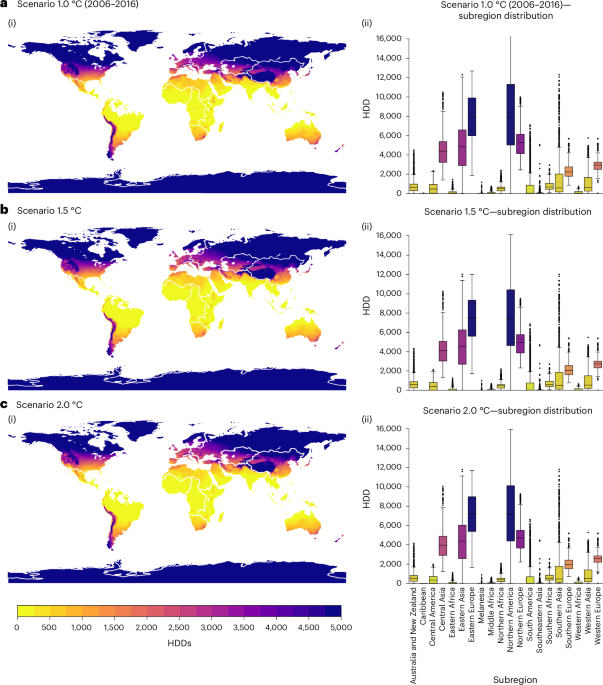
Researchers have published a comprehensive global gridded dataset mapping heating degree days (HDDs) and cooling degree days (CDDs) under projected global mean temperature rises of 1.0 °C, 1.5 °C, and 2.0 °C above pre-industrial levels. The dataset, detailed in a study in Nature Sustainability, comprises 30 gridded maps at 0.883° × 0.556° resolution, characterized by five statistical metrics for each scenario and variable.
The analysis highlights a widespread trend of declining HDDs globally, signaling reduced heating requirements in many regions, which has implications for natural gas and heating fuel markets. Conversely, CDDs are projected to increase nonlinearly, indicating a substantial escalation in energy demand for air conditioning and cooling infrastructure worldwide.
Focusing on the 2.0 °C threshold, the data projects severe impacts on population exposure to extreme heat conditions. Using the Shared Socioeconomic Pathway 2-4.5 as a reference, the population experiencing CDDs exceeding 3,000 is expected to nearly double by 2050. This surge impacts populations from 1.54 billion (23%) in 2010 to 3.79 billion (41%).
Geopolitical implications arise from the geographical concentration of this increased thermal stress. The largest populations projected to face these extreme cooling demands are concentrated across South Asia and Sub-Saharan Africa, specifically naming India, Nigeria, Indonesia, Bangladesh, Pakistan, and the Philippines. These nations face significant infrastructure and energy grid stress.
The research team made the data accessible via the Oxford University Research Archive (ORA), alongside the underlying code hosted on GitHub, to facilitate immediate application in policy development. Availability of this granular data supports better alignment between national development goals and climate adaptation strategies.
Experts suggest this HDD–CDD dataset provides the robust foundation necessary for embedding climate variability information directly into long-term sustainability planning and energy policy formulation. The findings underscore the urgency of energy efficiency measures focused on cooling technologies, aligning with global efforts to meet Sustainable Development Goals.