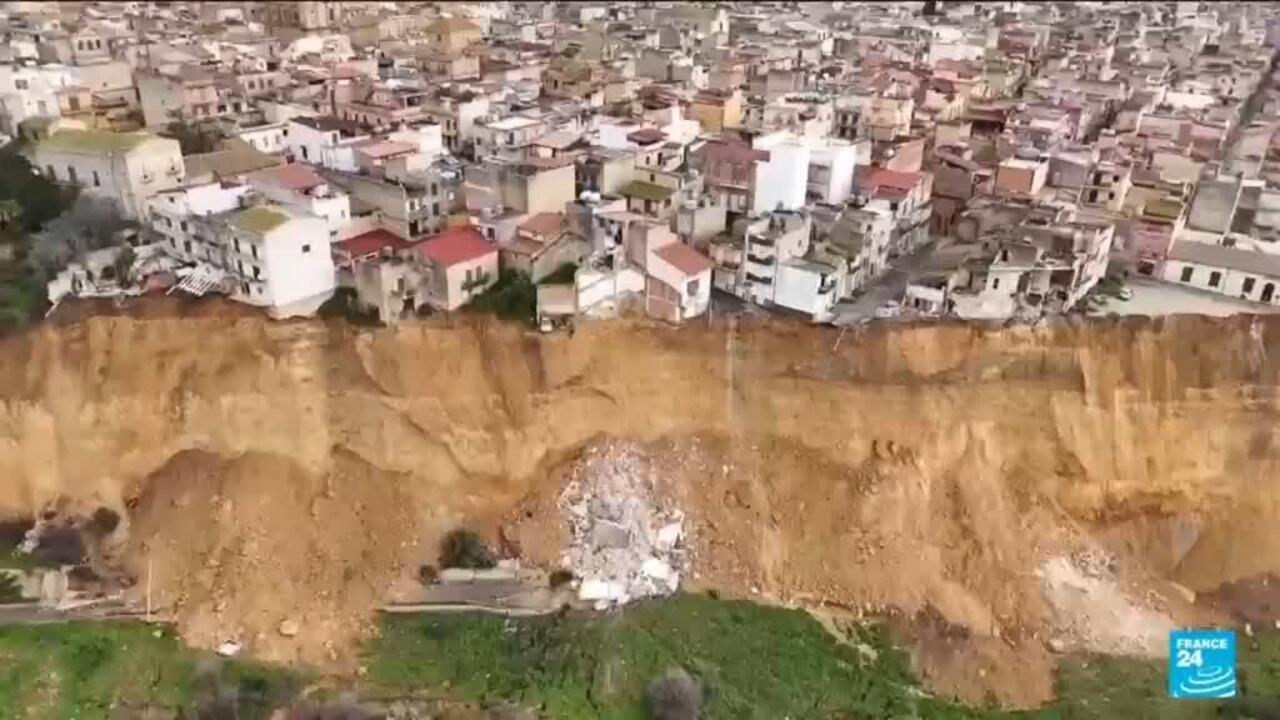
The regional stability of Southern Italy faces renewed scrutiny after a significant geological event struck the Sicilian town of Niscemi. A four-kilometer stretch of hillside collapsed on January 25th, prompting authorities to declare the area a 'red zone' and enact the emergency evacuation of around 1,500 inhabitants. While initial reports confirmed no casualties, the underlying geological vulnerability remains the primary concern for regional governance.
This critical destabilization event followed a period of intense, severe weather that battered the region in the preceding days. Niscemi, situated on inherently unstable substrata, appears particularly susceptible to saturation-induced mass movement, a pattern increasingly observed across climate-vulnerable Mediterranean coastlines.
Geotechnical assessments conducted post-event indicate that the fissure continues to exhibit potential for expansion. Experts have issued stark warnings that subsequent heavy rainfall could trigger further slippage, potentially compromising additional housing stock beyond the currently evacuated perimeter. This necessitates immediate, costly stabilization or managed retreat strategies.
The gravity of the situation prompted a high-level governmental response, with Italian Prime Minister Giorgia Meloni visiting the affected area on January 28th to assess the damage and coordinate federal aid deployment. Such events place immediate fiscal strain on municipal and national budgets, diverting resources from critical infrastructure projects to emergency response and long-term environmental mitigation.
From an economic perspective, the incident underscores the escalating liability associated with developing in geologically sensitive zones, particularly as global climate models project increased intensity of precipitation events across the Mediterranean basin. Insurance and reinsurance markets will closely monitor the required remediation costs, which could climb significantly if the slope fails to stabilize.
This localized crisis in Sicily mirrors broader international challenges concerning climate adaptation and urban planning resilience. Nations with extensive historical infrastructure built upon challenging topography must now rapidly recalibrate risk models to account for the increased frequency of these high-impact, low-probability weather-induced geological failures.
Mitigation efforts will likely involve complex engineering solutions, potentially including extensive drainage works, soil reinforcement, or, in the most severe cases, the planned demolition and relocation of at-risk properties. The long-term socio-economic impact on Niscemi will depend heavily on the speed and efficacy of these geotechnical interventions. (Source: Derived from reporting by France 24 and associated wire services.)