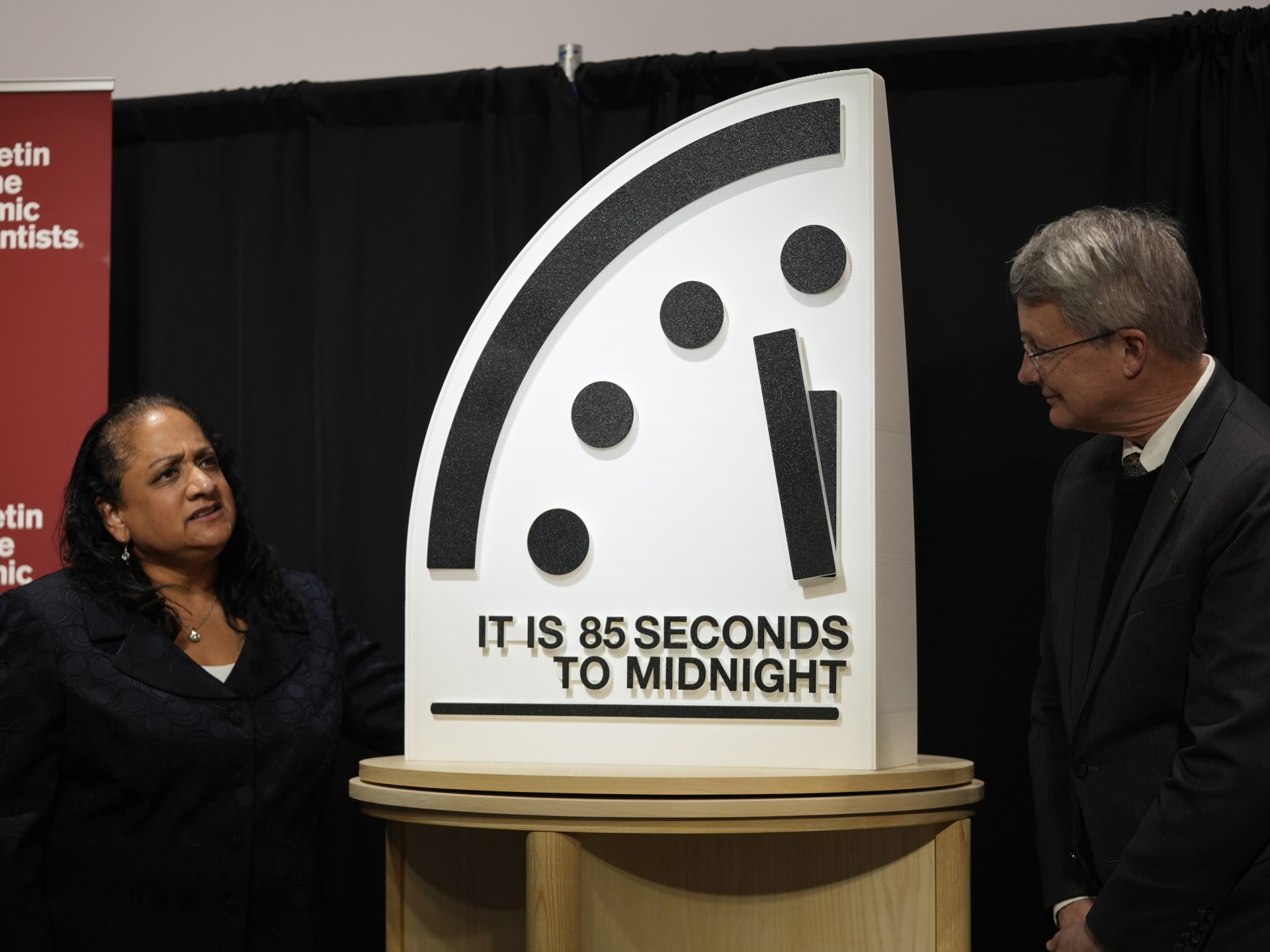
Doomsday Clock Hits Record 85 Seconds to Midnight as Global Risks Surge
Global scientists have delivered their starkest warning yet about humanity's survival prospects, setting the symbolic Doomsday Clock at a record 85 seconds to midnight for 2025—the closest to global catastrophe since the timekeeper's inception in 1947.The Bulletin of the Atomic Scientists, the prestigious organization co-founded by Albert Einstein, cited a convergence of escalating threats including nuclear proliferation, climate policy failures, and the emergence of aggressive nationalism among major powers as driving factors behind the grim assessment."The Doomsday Clock's message cannot be clearer. Catastrophic risks are on the rise, cooperation is on the decline, and we are running out of time," said Alexandra Bell, president and CEO of the Bulletin of the Atomic Scientists, during Tuesday's announcement in Washington.The assessment reflects growing concern over what scientists describe as a breakdown in international cooperation precisely when global coordination is most critical. The bulletin specifically highlighted increasingly "aggressive, adversarial, and nationalistic" behavior from major powers including Russia, China, and the United States.Geopolitical tensions reached new heights in 2025, with the organization pointing to Russia's ongoing war in Ukraine, renewed clashes between India and Pakistan in May, and coordinated US-Israeli strikes on Iran in June as evidence of deteriorating global stability.On climate action, the scientists delivered a scathing critique of international responses, describing efforts as ranging "from wholly insufficient to profoundly destructive." The assessment noted that the three most recent UN climate summits failed to emphasize fossil fuel phase-outs or carbon monitoring mechanisms.Particular criticism was reserved for US President Donald Trump's climate policies, with the bulletin stating he has "essentially declared war on renewable energy and sensible climate policies, relentlessly gutting national efforts to combat climate change."However, the assessment acknowledged some positive developments, noting that renewable energy sources achieved record growth in 2024, with wind and solar capacity expanding significantly. For the first time, renewable and nuclear energy combined surpassed 40 percent of global electricity generation.Daniel Holz, professor of physics at the University of Chicago and chair of the Bulletin, emphasized that rising autocratic nationalism compounds existing threats. "Our greatest challenges require international trust and cooperation, and a world splintering into 'us versus them' will leave all of humanity more vulnerable," Holz warned.The Doomsday Clock has fluctuated dramatically since its creation, reaching its safest point of 17 minutes to midnight in 1991 following the Cold War's end and subsequent nuclear arms reductions. The current 85-second setting represents the most pessimistic assessment in the clock's 79-year history, surpassing previous lows during the height of Cold War tensions.The bulletin's warning comes as global markets increasingly price in geopolitical risks, with defense spending reaching record levels across major economies and international trade relationships showing signs of strain under mounting political pressures.