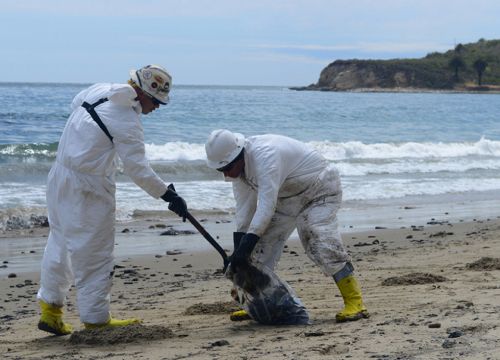
Authorities have removed 889 tons of hydrocarbon waste from beaches across Veracruz and Tabasco after oil washed ashore along the Gulf of Mexico. A joint statement from federal agencies confirmed that cleanup operations remain active across 48 beaches in the region.
While crews have cleared oil from 32 of those beaches—25 in Veracruz and seven in Tabasco—the interagency task force continues to monitor the coastline. More than 3,145 personnel from the Secretariat of the Navy, Pemex, and environmental protection agency Profepa are currently deployed to the area.
A massive logistical operation
To contain the spill, workers have installed 2,000 kilometers of containment barriers. Officials have also conducted 475 inspections covering 630 kilometers of coastline, supplemented by aerial surveillance flights to detect any new spills and track the progress of the cleanup.
Petróleos Mexicanos (Pemex) has deployed 780 workers directly to the cleanup sites. Because the work requires rotating, temporary schedules, the government has hired 958 additional people to meet localized demand.
Local authorities are prioritizing the needs of fishing communities directly affected by the environmental damage. “The interinstitutional operative for the attention of the presence of hydrocarbon on the Gulf of Mexico littoral is maintained,” the joint statement noted.
In Veracruz, the government is hiring local residents and fishermen in Agua Dulce, Coatzacoalcos, Pajapan, Mecayapan, and Tatahuicapan to assist with remediation efforts. Similar hiring efforts are underway in the Tabasco municipalities of Paraíso and Cárdenas.
Beyond direct employment, the government is distributing fuel assistance to offset losses for the fishing industry. Municipalities in southern Veracruz, including Alvarado and Medellín, will receive donations of gasoline and diesel. Officials are currently in the process of delivering 100,000 liters of fuel to Pajapan.
In Tabasco, fishing cooperatives will receive a distribution of 1,360 liters of fuel per registered vessel. This assistance follows agreements reached with the organized fishing sector to support those whose livelihoods have been disrupted by the oil arrival.