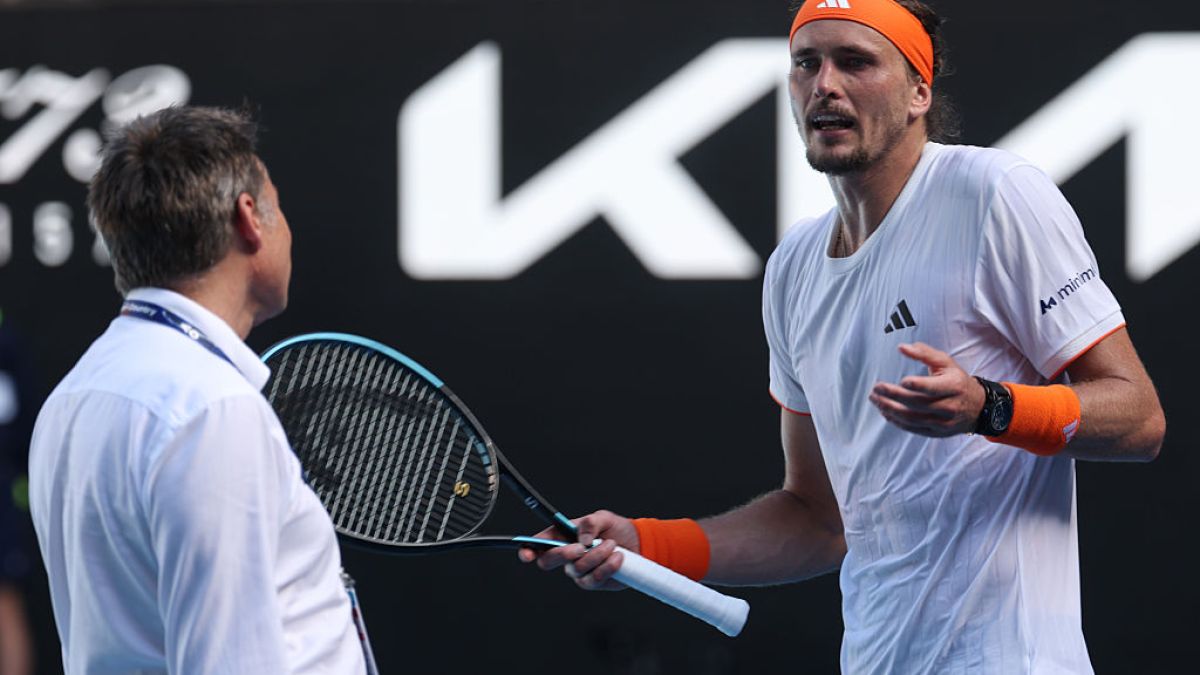
Third seed Alexander Zverev condemned match officials for permitting Carlos Alcaraz a medical timeout for a leg issue during their five-set Australian Open semifinal defeat on Friday. World number one Alcaraz received treatment for his right thigh at the change of ends while leading in the third set, prompting an immediate, vocal protest from the German player.
Zverev asserted during his post-match news conference that Alcaraz was experiencing cramping, a condition he stated should preclude the granting of an official medical timeout under standard regulations. Following the treatment, Alcaraz dropped the subsequent two sets but returned to full mobility to secure the 6-4 7-6(5) 6-7(3) 6-7(4) 7-5 victory after five hours and 27 minutes.
On court, Zverev reportedly used profanity while addressing the match supervisor during the delay, later confirming to reporters that he found the situation 'b******t.' The German noted that Alcaraz appeared to take nearly an hour and a half off-court where movement was minimal, allowing for significant recovery before the crucial closing set.
Alcaraz, while acknowledging fatigue after the marathon contest, offered an ambiguous response when questioned about the injury's severity, stating his body 'could be better' but that exhaustion was normal after such duration. Zverev was serving for the match at 5-4 in the decisive fifth set before Alcaraz rallied to claim the final three games, denying the German a spot in the final.
This result marks another near-miss for Zverev in his pursuit of a maiden Grand Slam title, though he expressed pride in his physical endurance throughout what he called one of the toughest matches of his career. He indicated that focusing on maintaining his current training regimen suggested a promising trajectory for the remainder of the season.
From a broader tournament perspective, the match sets a high physical benchmark for Alcaraz heading into the final against Jannik Sinner. The prolonged duration and the controversy surrounding the mid-match stoppage will likely generate internal reviews regarding the interpretation and enforcement of medical timeout protocols by tournament supervisors.