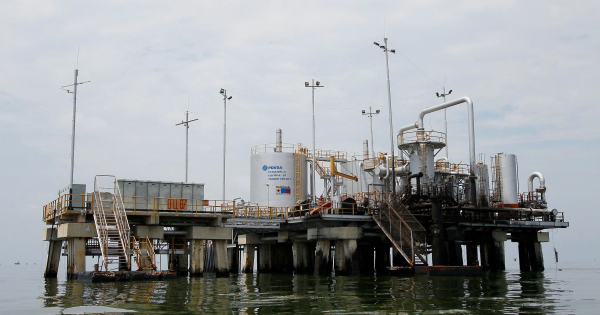
The administration of former President Donald Trump is reportedly planning a significant push to revitalize Venezuela's declining oil industry, projecting a $100 billion investment to restore its former production capacity. This strategy follows political developments aimed at replacing Nicolás Maduro, positioning the reactivation as a key economic prize in Latin America.
Despite the administration's optimism, industry sentiment remains divided, as Exxon CEO Darren Woods recently labeled Venezuelan oil assets as "non-investable" during a White House meeting. Conversely, US Energy Secretary Chris Wright stated that companies including Chevron, Shell, Repsol, and ENI expressed readiness to immediately increase their Venezuelan exposure, suggesting a fractured view on risk versus reward.
Any international firms engaging in Venezuela face substantial liabilities stemming from thousands of asset nationalizations under former President Hugo Chávez, with independent estimates suggesting recovery costs could approach $180 billion. Economists like José Manuel Puente calculate that achieving significant output levels would require both the $180 billion investment and approximately fifteen years of institutional stabilization.
In response to industry pressure for legal certainty, the interim government has submitted a new Hydrocarbons Law and a Streamlining Procedures Law to the National Assembly. These proposals aim to incorporate productive sharing contracts from the Antiblockade Law, allowing foreign firms to recoup investments via crude sales, though companies seek reduced fiscal burdens and greater control over exports.
Venezuela's existing infrastructure, essential for handling its estimated 300 billion barrels of Orinoco reserves, is reportedly in poor condition, requiring substantial capital expenditure beyond initial investment projections. Furthermore, the reserves consist primarily of heavy and extra-heavy crude, demanding complex and expensive extraction and refining processes.
Economically, initial positive signals followed the political transition, including a surge in the Caracas Stock Exchange index and a reduction in the black-market exchange rate, partially attributed to an anticipated $330 million oil sale routed through US channels. The interim government announced the creation of two sovereign wealth funds to address public salaries and failing public services.
Geopolitical alignments remain complex, as Venezuela has historically been a major debtor to China through infrastructure financing, such as an unfinished railway network. The current energy pivot places Caracas back at a strategic intersection between US energy interests and existing Chinese investment commitments in South America.