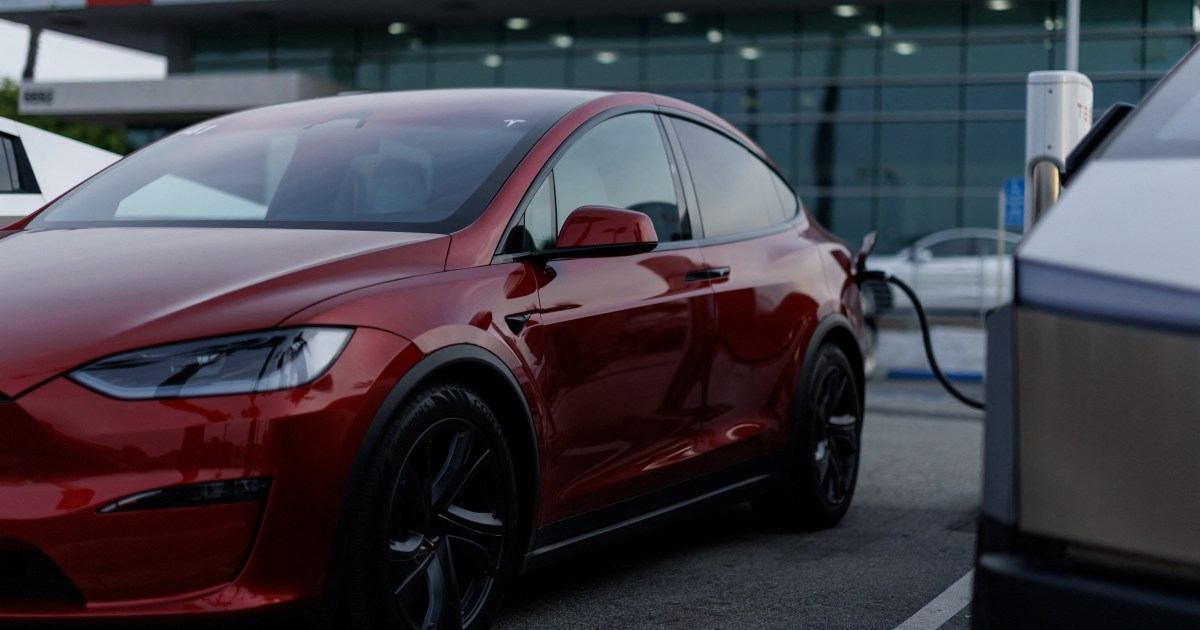
Tesla, the electric vehicle manufacturer led by Elon Musk, announced on Wednesday its first year-over-year decline in annual revenue, according to figures released amidst a major earnings reporting period. Quarterly revenue for the final three months of 2025 fell three percent to $24.9 billion, while full-year revenue settled at $94.8 billion, down from $97.7 billion in 2024.
Net profit experienced a significant contraction, dropping sixty-one percent to $840 million in the fourth quarter alone. Full-year net profit for 2025 was $3.8 billion, a sharp decrease compared to the $7.1 billion reported for the preceding fiscal year. This downturn reflects mounting pressures within the global automotive sector and increased competition.
Concurrently, the Austin, Texas-based firm disclosed an agreement to inject $2 billion into xAI, Musk’s artificial intelligence startup developing the Grok chatbot. Tesla stated this capital allocation is intended to bolster its capacity to deploy AI products and services into the physical domain at scale, signaling a strategic pivot.
The company explicitly framed the xAI investment as a move designed to lessen its dependence on the traditional automotive market, highlighting the growing importance of software and advanced compute capabilities. Following the announcement, Tesla shares registered a modest increase of approximately two percent in after-hours trading.
This earnings disclosure occurred on a day when major technology competitors demonstrated robust financial health, potentially highlighting diverging sector performance. Meta reported fourth-quarter revenue of $59.9 billion and profit reaching $22.8 billion, causing its shares to surge nearly seven percent in extended trading.
Microsoft also signaled strong momentum, posting $81.3 billion in revenue and a sixty percent profit rise to $38.5 billion for the quarter, according to statements released to shareholders. However, Microsoft’s record capital spending of $37.5 billion on AI infrastructure fueled concerns about investment sustainability, leading to a six percent stock decline.
Samsung Electronics, the world's largest memory chip producer, further underscored the strength in the semiconductor segment, reporting a quarterly profit exceeding $13.9 billion, more than triple the result from the previous year. These contrasting results frame Tesla's revenue contraction against a backdrop of accelerating AI capital deployment across the tech industry.
The broader implication suggests that while established automakers face demand softening, significant capital reallocation is occurring toward core AI development irrespective of immediate profitability concerns at competitor firms. Investors will closely monitor how Tesla integrates xAI capabilities to revitalize top-line growth.