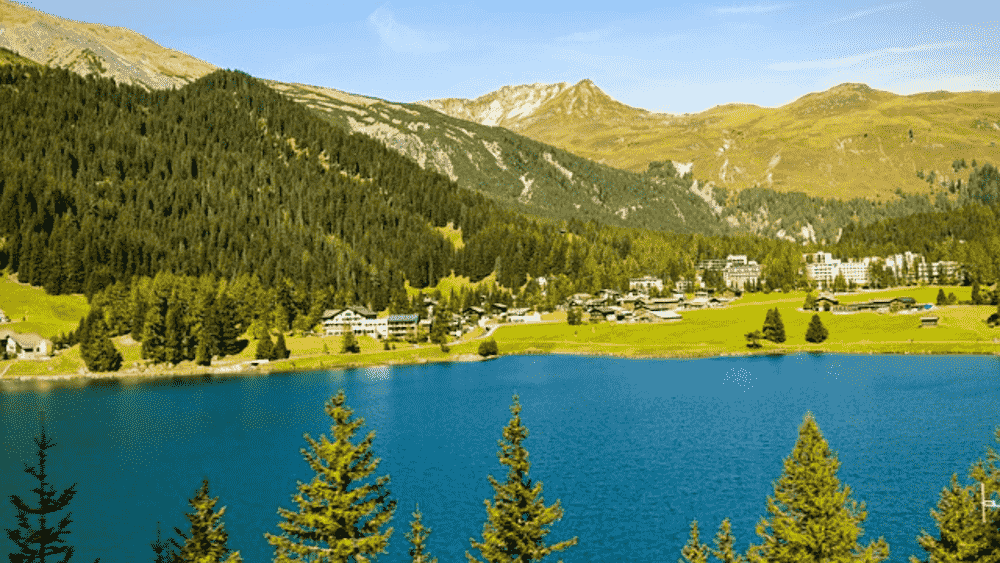
Davos, a town in the canton of Graubünden, serves as the permanent host for the World Economic Forum since 1971.
While known for skiing, the municipality functions as a critical node for global economic diplomacy and high-level policy discussions.
The town's strategic isolation and developed infrastructure make it a secure venue for international leaders.
According to a report by Switzerlanding, the settlement sits at 1,560 meters above sea level between the Pleasure and Albula Ranges.
This altitude provides a natural barrier that historically contributed to its development as a wellness resort in the 1800s before becoming a ski area.
The geography supports security protocols required for such high-profile summits.
The World Economic Forum attracts thousands of delegates who rely on the region's transport network to access the town.
The Rhaetian Railway connects Davos to major European hubs, utilizing structures like the Landwasser Viaduct.
This railway viaduct, built between 1901 and 1902, stands 65 meters high and remains a UNESCO World Heritage Site today.
Connectivity extends beyond the immediate valley into neighboring regions through passes like the Flüela Pass.
This mountain pass connects the Landwasser Valley with Susch in the Lower Engadin and reaches an elevation of 2,383 meters.
Access is seasonal, closing in winter due to avalanches, which dictates the flow of logistics during peak summit periods.
Local infrastructure supports a dual economy driven by both tourism and the annual gathering of business leaders.
The region contains 300 kilometers of ski slopes and 50 ski lifts to accommodate winter visitors.
These facilities represent significant capital investment that maintains the town's appeal year-round.
The revenue generated supports municipal services that also cater to the summit's logistical needs.
Cultural assets like the Kirchner Museum also contribute to the town's soft power and international reputation.
The museum houses more than 1,500 pieces of work by German artist Ernst Ludwig Kirchner, who moved to Davos in 1917.
Such cultural depth adds to the destination's attractiveness for international visitors outside the forum schedule.
The Bernina Express and Glacier Express trains depart from the area, linking Switzerland to Italy and Zermatt.
The Bernina Express runs from Davos to Tirano over a period of four hours.
These scenic routes facilitate cross-border travel that supports regional economic integration.
Passengers often use these services for business travel, blending leisure with professional duties.
Historical population growth reflects the town's evolving role over centuries.
Originally populated in the 13th century, the area now supports around 11,000 people.
The population density remains low enough to manage large-scale events without overwhelming local services.
Future developments will likely depend on sustained interest in multilateral economic cooperation.
The continuity of the forum relies on the town's ability to maintain its infrastructure and security standards.
Observers will watch how Davos adapts to changing geopolitical tensions during upcoming summits.
Investment in transport networks remains a priority for local authorities to ensure seamless access.
The combination of natural beauty and functional utility ensures Davos remains a unique global venue.
Reports indicate that the Sertig Valley offers hiking trails and traditional villages that contrast with the high-stakes meetings in the town center.
This juxtaposition highlights the balance between leisure and governance in the region.